


Unlock the Editor’s Digest for free
Roula Khalaf, Editor of the FT, selects her favourite stories in this weekly newsletter.
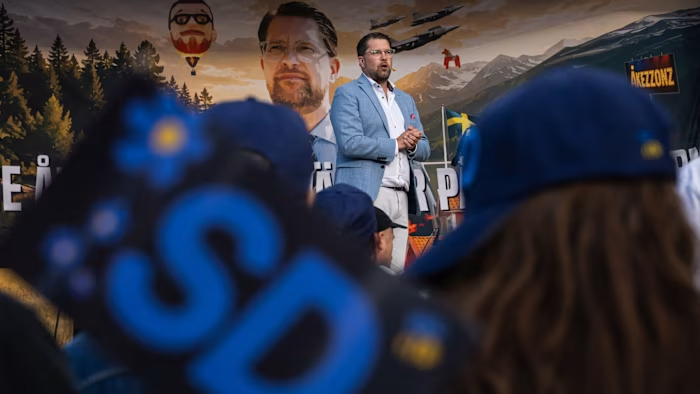
Sweden could see a party with neo-Nazi roots enter government for the first time after Sunday’s elections, a watershed moment in securing a formal role after years of reshaping the debate on migration and crime from outside power.
The nationalist Sweden Democrats, who are not at present part of the centre-right coalition but support it from parliament, are expected to remain the biggest party on the right on Sunday, allowing them to receive the most ministerial posts.
Opinion polls suggest a tightening race but still give a slender lead to opposition leftwing parties.
Centre-right Prime Minister Ulf Kristersson from the Moderates is campaigning for the first time to allow the Sweden Democrats to join the coalition, even if he keeps his post. The Sweden Democrats have been excluded from the coalition until now because their views were judged as too extreme.
“It is a huge step,” said Jenny Madestam, a political scientist at Södertörn University. “The Sweden Democrats have been very successful in shifting the way we perceive our society and the nation. The whole Swedish society has shifted to the right.”
Their breakthrough has smashed another taboo in Europe that has seen an increase in support for far-right parties, such as the AfD’s success at the weekend in the German state of Saxony-Anhalt.
Unlike the AfD or France’s Rassemblement National, the Sweden Democrats, under leader Jimmie Åkesson, have already started to chip away at the cordon sanitaire once placed around them. They are the intellectual force behind a lot of the current government’s policies on gang crime and bringing the level of asylum seekers to its lowest level in 40 years, even if they are outside the coalition.
Should they enter government after Sunday, they would join similar anti-immigration populist parties in neighbouring Norway and Finland that have entered government.

But the Sweden Democrats stand out. Unlike their Nordic counterparts, who were largely born out of the libertarian, anti-tax movements, they had their roots in the neo-Nazi movement and antisemitism, something the party apologised for last year.
“It was important for ourselves, but also the future of the party,” Mattias Karlsson, chief ideologue of the Sweden Democrats, told the FT. He argued that the apology led to the Liberals — the smallest of the rightwing parties — finally accepting that the Sweden Democrats could enter government.
Their biggest obstacle to power is their old nemesis: the traditional party of power in Sweden, the centre-left Social Democrats who lead the opinion polls.
Karlsson argues that electing a leftwing government could threaten the measures on gang crime and migration that his party has successfully pushed for. One or more parties on the left have voted against almost every restrictive measure the government has imposed.

So successful have the Sweden Democrats been in imposing their agenda that there is a sense both inside and outside the party that they need new policies to increase their share of the vote from the 21 per cent they received in 2022.
“They have been super successful so almost everything on their list has been ticked. How should the Sweden Democrats reinvent themselves?” said Madestam.
Karlsson acknowledged that the party was trying to “broaden our base” by appealing to new groups such as Swedes living abroad, the wives of some of its male voters and, most strikingly, non-Muslim immigrants.
“We can see that on single issues they agree with us to quite a large extent, but there’s a fear,” he said of the immigrants.
There has still been controversy surrounding the Sweden Democrats, especially after one of its MPs called the Social Democrat leader Magdalena Andersson a “quisling” or traitor, and after an aide to a senior leader was accused of spreading pro-Russian propaganda.
Prime Minister Kristersson told the FT that he condemned such comments but added that there was a “harsh” tone on both sides.

Of the Sweden Democrats entering government after Sunday, he merely said: “I don’t see the drama in it.”
The prime minister underscored that together with the nationalist party his current three-party coalition had passed eight budgets in four years, unlike the previous centre-left government, which failed to pass three of its budgets. “It has been very orderly, not easy in any way, but without crisis,” he added.
That allows both him and the Sweden Democrats to present themselves as representing stability against potential chaos if the left wins, as Andersson has refused to say what kind of coalition she would like to form. She in turn told the FT she was worried for her country should the Sweden Democrats gain 12 or more ministerial positions. “Sweden would be a different country,” she added.
The right has also benefited from controversy on the far left, including how several members of the Left Party of former communists have expressed anti-Jewish views and supported Palestinians convicted of terrorism.
For many in Stockholm, whichever side wins on Sunday, the elections will represent merely another stepping stone for the Sweden Democrats towards their ultimate goal of running the country.
Karlsson said it was “quite a hard sell” to its voters not to enter government. He added: “It’s only natural that we are being treated like other parties and this separate treatment of us ends completely. The last step on that ladder would, of course, be to get our party leader accepted as prime minister by other parties. But we are not there yet.”
Data visualisation by Alan Smith
