


This article is part of FT Globetrotter’s guide to Edinburgh
Among the many pleasures of travelling in Scotland, few leave a more lasting impression than coming across a striking view of one of the nation’s venerable castles and delving into its rich history. And there is nothing like a nice swim in Scotland’s clear waters to make a day even more memorable. Fortunately from my base in Edinburgh, it is easy to combine all three pleasures.
Many of Scotland’s finest castles are built on the scenic shores of its lochs, rivers or sea, locations that often made them much easier to defend. Some were specifically built to guard strategic waterways or to provide secure bases for maritime power. Almost all have grand tales to tell of events from their often tumultuous past. And while Scottish waters can be a little chilly, I have always found that taking a dip gives a visceral sense of entering the landscape and often a fresh perspective on even familiar scenes.
So-called “wild swimming” is increasingly popular in Scotland, where broad rights to roam* mean you are unlikely to be prevented from entering most bodies of water as long as you judge it safe and cause no damage or disturbance to wildlife. I have enjoyed swimming near dozens of historic castles all around Scotland. Here are four of the best such swims to try within easy distance of Edinburgh.
Tantallon Castle
Near North Berwick, East Lothian EH39 5PN

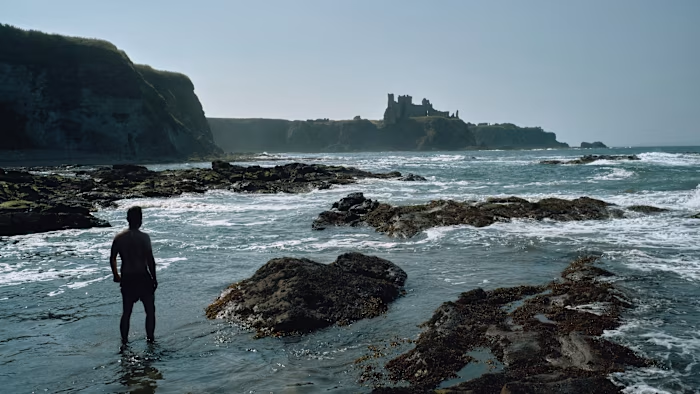
One of Scotland’s most imposing medieval fortifications, Tantallon Castle stands atop a high promontory jutting out into the Firth of Forth about an hour’s drive east of Edinburgh. It’s now a very substantial ruin, and ticket-bearing visitors can in summer easily enter the castle from its landward side. But instead of the standard visit, why not take the more challenging approach along the rocky coast to the castle’s east and, if conditions permit, a short swim out into the Forth? This will give you an impressive perspective of the castle’s natural and man-made defences.
The steep cliffs that guarded the castle on its seaward sides, together with the wide dry moat, grand gatehouse and thick curtain wall of rose-red sandstone that shielded it to the south, made Tantallon a bastion from which even royal authority could be defied. In 1528, a siege led by King James V against the rebellious Archibald Douglas, the 6th Earl of Angus, failed to take the fortress after its walls withstood a 20-day bombardment by royal cannon. Never before in Scotland’s history, crowed Douglas afterward, had such “pane travell expensis and diligence” (pain, travel, expense and diligence) been expended unsuccessfully for the “wynnyng of ane house” (winning of a house).

In standing his ground at Tantallon, Douglas was following the example of his 14th-century ancestor, Margaret, Countess of Angus and Mar. A widowed heiress to estates in Scotland’s north-east, Margaret lived in the castle as the mistress of the first Earl of Douglas and mother of his son. But her position became precarious when the earl and his successor died and she was ordered to return Tantallon to its feudal superior, the Earl of Fife — son of the king and guardian of the kingdom.
Instead of meekly submitting, Margaret gathered local gentry and kinsmen at Tantallon, where they held out through the winter of 1388-89 until Fife cut a deal, promising to allow the countess to remain in the castle and to support her, her men and her lands “agayns ony that wald wrang thaim” (against any that would wrong them). The accommodation secured the positions of Margaret’s local supporters and cleared the way for her to establish her illegitimate son George as the first of a new line of earls of Angus. It also demonstrated the influence and authority that independent-minded aristocratic women could exercise in a male-dominated and often violent age.

Tantallon’s walls were eventually humbled by the more modern artillery of Oliver Cromwell during the English dictator’s conquest of Scotland in 1651, but the castle’s ruins were to fire the imaginations of author Walter Scott and painter Alexander Nasmyth in the 19th century.
Nasmyth’s view of the castle from the coast, complete with stormy seas and a shipwreck, is a masterpiece of Scottish Romantic painting. For a similar perspective and a wonderfully scenic swim — though only in much calmer weather — take a bus or drive to Seacliff Beach. The nearest bus stop is at Auldhame Farm and there is paid parking at the beach. From Seacliff, walk westwards past the little old harbour carved in the rocks. Be careful not to pass any headland while the tide is rising to ensure you can easily return. The view of Tantallon becomes ever more dramatic as you approach. Website; Directions
St Andrews Castle
The Scores, St Andrews, Fife KY16 9AR
Another clifftop fortress, this time an hour and a half’s drive north-east of Edinburgh, St Andrews Castle was for centuries the residence of influential Catholic clerics before becoming a battleground in the Protestant Reformation that wracked Scotland in the 16th century. It was here in 1546 that Cardinal David Beaton presided over the show trial of evangelical preacher George Wishart, who after his conviction was strangled and burned at the stake outside the castle walls. Months later, the castle was seized by vengeful local lairds and evangelicals, who killed Beaton and hung his body from the walls. The fitful siege that followed drew the attention of England, which supported the Protestant rebels, and Catholic France, Scotland’s traditional ally and the birthplace of Scotland’s dowager queen, Mary of Guise, the mother of Mary Queen of Scots.

Provisions sent by sea to the besieged castle by England’s Henry VIII helped the rebels hold out for more than a year, but it was France’s intervention that proved decisive. In July 1547, King Henry II of France secretly dispatched a small fleet to St Andrews under a brilliant Italian commander equipped with detailed information of Scotland’s coastal waters. A few hours of intense bombardment from the sea and land broke the walls of the castle and the will of its defenders. The assault was, in the words of historian Jane E A Dawson, a “masterclass in the swift reduction of a fortified position”.
For a sense of the sight that would have greeted the arriving French fleet, take a bus or drive to St Andrews and walk to the Castle Sands, a beach below the fortress. There is a well-used though dilapidated tidal pool (swimmable in when the tide is out), but confident swimmers can venture further out for a better view of the castle’s seaward cliffs and walls. Website; Directions
Neidpath Castle
Peebles, EH45 8NW

This venerable building is a fine example of the strong verticality of form that makes Scottish tower houses such a distinctive and picturesque contribution to the national landscape. More seriously fortified than many such towers, it was likely built in the late 14th or 15th century and stands on a precipitous slope above the River Tweed about an hour’s drive south of Edinburgh. Viewed from the water, it has an impressive monumentality only slightly relieved by its irregular scattering of windows.
Like Tantallon, Neidpath fell victim to Cromwell’s 17th-century artillery, which emphatically demonstrated the obsolescence of defensive architecture across Scotland. But unlike the more massive coastal castle, Neidpath continued to be occupied afterwards. It even had a brush with the new thinking of the Scottish Enlightenment, when in 1795 it became the residence of Adam Ferguson, a historian and philosopher widely seen as a founding father of modern sociology.


Ferguson, who rented the property from the Duke of Queensberry, was charmed by the beauty of the castle’s situation. “The woods, the hills, and the river, are Elysian, and the atmosphere all composed of vital air,” Ferguson wrote, expressing sentiments likely to be shared by a modern visitor. That was in summer, however, and like many castle residents who lack serving staff or adequate heating, he found winter conditions tougher. Ferguson was as much a master of his feelings as any Stoic, a biographer recounted, “but the discomforts attendant upon his residence at Neidpath were a sore trial for his philosophy”.

To enjoy Neidpath from the water on a warm day, take a bus or drive to Peebles and from there follow the easy circular walk starting on the south side of the Tweed, crossing the river by the old viaduct and returning eastward to pass directly below the castle. There is a popular swimming spot a little west of Neidpath with a fine view of the castle on its leafy bank, but for maximum visual drama use the little beach below it. From there, its ancient walls loom starkly overhead against the sky. The current can be brisk and the river should never be entered when it is in spate. Website; Directions
Lochleven Castle
Pier Road, Fife, Kinross KY13 8UF
The end of the St Andrews siege did not end the struggle to decide Scotland’s religious and diplomatic loyalties. The resourceful Mary of Guise fought hard as regent to maintain Catholicism and ties with France. But by the time her daughter Mary Queen of Scots returned from France to exercise her monarchy in August 1561, Protestantism was dominant among the population and the fractious nobility, and ties with Protestant England increasingly close. Though the younger Mary’s religious tolerance and personal charisma initially stabilised her reign, less than seven years later a series of political mis-steps and disastrous alliances would leave her in ignominious imprisonment in Lochleven Castle.

Situated on a small island half a mile from the shore of the expansive Loch Leven, about halfway between Edinburgh and St Andrews, the castle seemed the most secure of prisons to the “Confederate Lords” who deposed Mary. Weakened by defeat and the traumatic miscarriage of twins, and under extreme psychological pressure, she agreed to abdicate in favour of her infant son, James. But as soon as her health returned she began to plan her escape. Less than a year after being ferried into captivity, she had won over some younger members of the Lochleven Castle household. One, a page known as “Little Willie”, agreed to row her across the loch. On May 2 1568, Willie sabotaged all but one of the castle’s boats, then opened the main gate for Mary with a key purloined from the laird while he and his family were dining. By the loch shore, another household admirer was waiting for them with horses.

Within days, an army of 6,000 men had mustered to Mary’s support. But panicking after defeat in a battle near Glasgow, she fled to England — a decision that led to long captivity and eventual execution. It was a sad end to one of history’s most romantic royal escapes.
Partial draining in the 19th century reduced Loch Leven somewhat and increased the size of the island, but the sight of the castle across the water would still be recognisable to its regal former prisoner. To enjoy the view from the water, take a bus or drive to Kinross and walk to Kirkgate Park, where there is a pleasant sandy beach. Toxic blue-green algae can be an issue in the loch in summer months, so check boards for any warnings or ask locals for guidance, and avoid the water if there is any sign of a bloom. Website; Directions
*Note: Scottish law gives broad rights to responsible access to land and waters, but “wild” swimming is always at your own risk. To avoid unseen hazards and potentially dangerous cold-water shock, always enter the water cautiously. Tailor any swim carefully to your ability. Check ahead for strong currents, tides, algae infestation or pollution
Have you swum in the shadow of a Scottish castle? Tell us in the comments below. Follow FT Globetrotter on Instagram at @FTGlobetrotter
Cities with the FT

FT Globetrotter, our insider guides to some of the world’s greatest cities, offers expert advice on eating and drinking, exercise, art and culture — and much more
Find us in Edinburgh, London, Tokyo, New York, Los Angeles, Istanbul, Paris, Lagos, Rome, Frankfurt, Singapore, Hong Kong, Miami, Toronto, Madrid, Melbourne, Copenhagen, Zürich, Milan, Vancouver and Venice
