
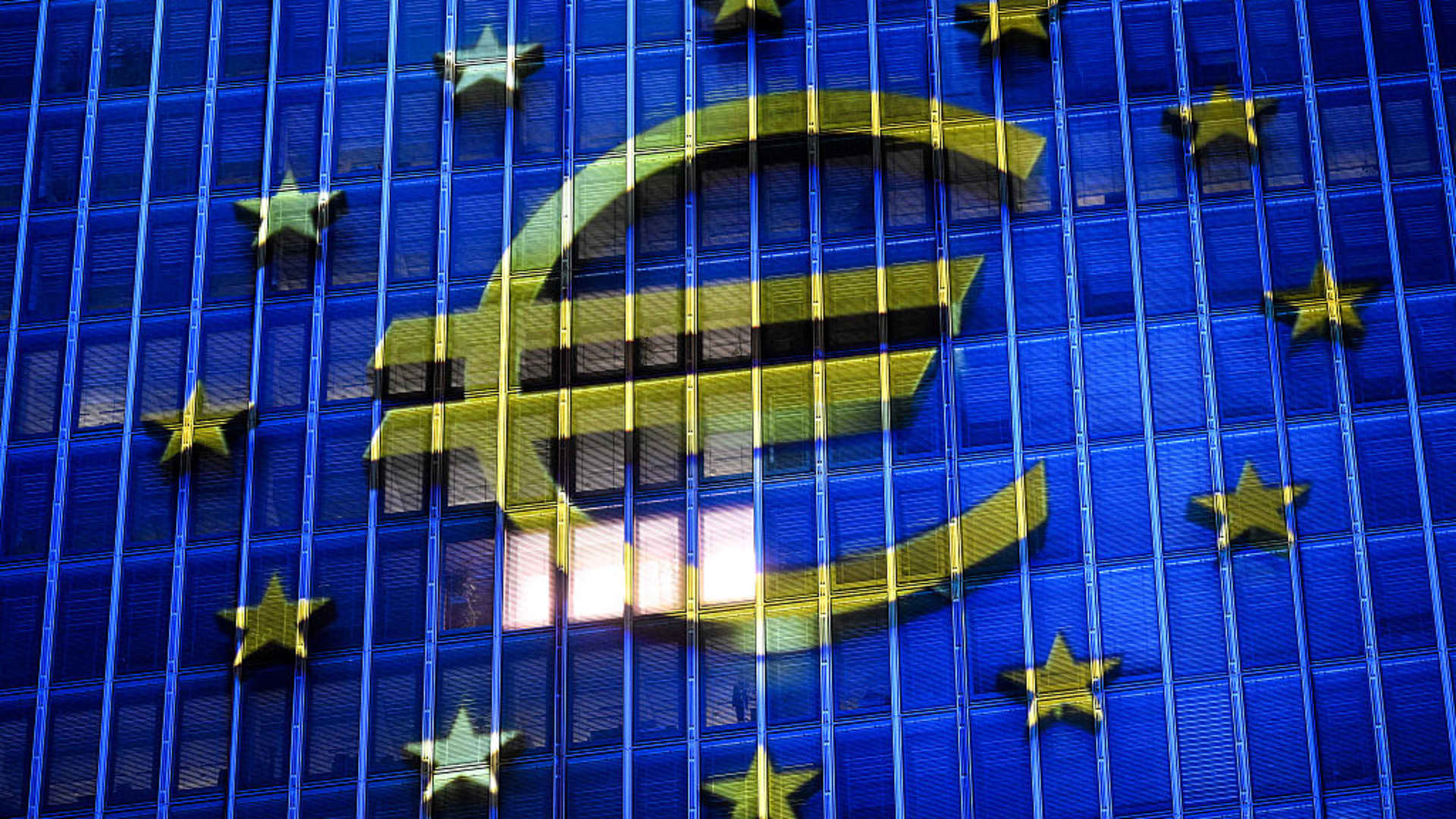
A projection of a Euro currency sign is pictured on the facade of the European Central Bank (ECB) headquarters in Frankfurt am Main, western Germany, on Dec. 30, 2025.
Kirill Kudryavtsev | Afp | Getty Images
European Central Bank policymakers face a dilemma as efforts to combat inflationary pressures with interest rate hikes risk tipping a fragile euro zone economy into recession — but they may not have to lift a finger.
Market expectations of forthcoming tighter monetary policy — meaning rate hikes — are already causing more restrictive financial and lending conditions, according to European economist at Goldman Sachs Alexandre Stott.
The “transmission of tighter policy is already underway,” he wrote in an analysis note published on Wednesday.
“Bank lending standards — which are particularly important in the euro area, where loans account for over half of all corporate financing — have already tightened notably and are likely to tighten further,” Stott said, adding that the challenge is assessing just how much restriction is being transmitted to the economy.
“On the one hand, most of the restriction underway is attributable to expectations of a higher policy rate. The [ECB’s] Governing Council will therefore have to deliver at least some of the expected hikes if it wants to weigh on demand and lean against inflationary pressures,” he said.
“On the other hand, around a quarter of the drag on the economy appears exogenous to monetary policy expectations, reducing the need to tighten policy significantly. This would, all else equal, support a cautious approach to raising rates, and is consistent with our forecast for two 25 basis point hikes in June and September.”
Market expectations
Markets are pricing in a high probability (around 91%) of a 25 basis point interest rate hike at the ECB’s next meeting on June 11 — which would take the bank’s key deposit facility rate to 2.25% — and a 50% chance of another rate hike later this year in September.
Hikes have been seen as increasingly likely as consumer prices surge in the euro area as a result of the Iran war, with euro area inflation jumping to 3% as of April. The next inflation print is due on June 2.
ECB policymakers have reiterated the stance of the central bank’s President Christine Lagarde, saying they will take a data-dependent and meeting-by-meeting approach to monetary policy. The ECB’s Vice-President Luis De Guindos told CNBC on Wednesday that central banks were having to weigh up the need to tame inflation without piling too much pressure on economic output.
“I think there is not any sort of fait accompli with respect to the evolution of rates. The discussion will be open and all the elements will be balanced and taken into consideration,” he told CNBC’s Annette Weisbach.
Bank of France Governor Francois Villeroy de Galhau, who is also on the ECB’s Governing Council, told CNBC earlier this week that European policymakers “will do what is necessary” to bring inflation back to its 2% target.
ECB credibility at stake
Economists diverge on whether the ECB should hike rates at all, given anemic euro zone growth; the last data pointed to an expansion of just 0.1% in the first quarter.
Holger Schmieding, chief economist at Berenberg, said last week that Europe’s “big three” economies — Germany, France and Italy — have been weakened by the recent spike in energy costs, leading to a stagflationary environment characterized by rising inflation and unemployment, and weaker growth.
Schmieding said demand destruction should “take care” of the inflation part of the stagflation dilemma, as consumers spend less on other items to cover higher energy costs — negating the need for aggressive tightening.
“It’s important to distinguish between what the central banks unfortunately are likely to do and what would be the right thing,” Schmieding told CNBC last week, adding: “My impression is that the European Central Bank is going to make a big mistake.”
Filippo Alloatti, head of Financials for Credit at Federated Hermes, said in an analysis note on Thursday that the ECB is stuck between a rock and a hard place.
“The economic impact of disrupted Middle East energy infrastructure is serious and uncertain. Even if tensions were to ease, there is a strong likelihood that oil prices will remain structurally elevated,” he said, with countries such as Germany and Italy particularly vulnerable to prolonged energy cost shocks.
“At the same time, the ECB is contending with the legacy of earlier policy mistakes of keeping interest rates too low for too long after the pandemic,” he added.
“As a result, the central bank is now under growing pressure to respond decisively to inflationary pressures and second-round effects. Anchoring inflation expectations has become paramount, and this points towards the need for a 25-basis point rate increase … as early as June.”
Ultimately, the bank’s credibility is at stake, Alloatti said.
“Any hesitation risks undermining confidence in its ability to maintain price stability, which, once lost, would be difficult to restore. The ECB needs to balance growth risks against inflation pressures while reinforcing its commitment to financial and monetary stability in an uncertain global environment.”
— CNBC’s Hugh Leask and Chloe Taylor contributed to this report.
