


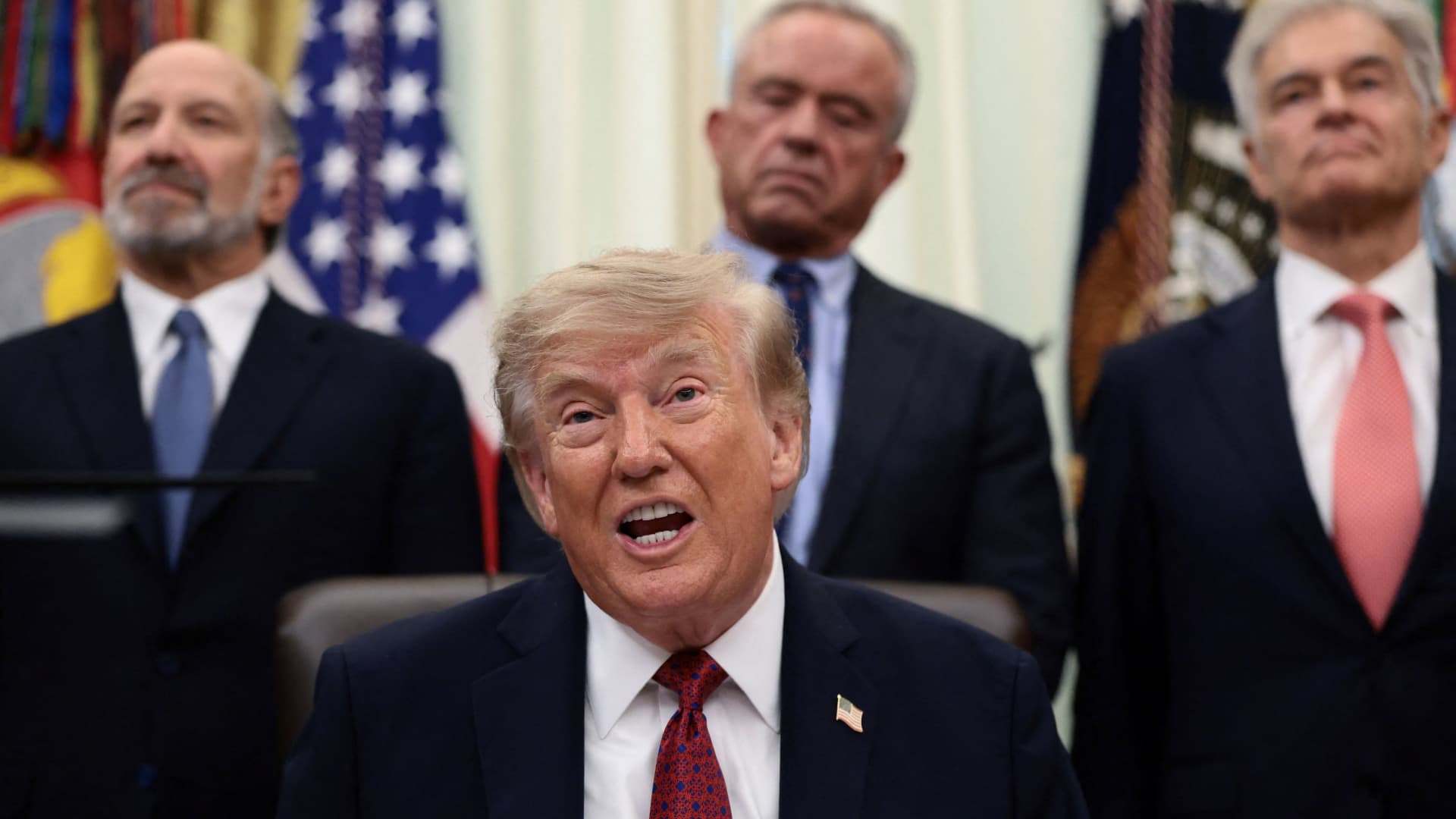
U.S. Secretary of Commerce Howard Lutnick, U.S. Secretary of Health and Human Services Robert F. Kennedy Jr., and U.S. Center for Medicare & Medicaid Services (CMS) Administrator Dr. Mehmet Oz stand behind U.S. President Donald Trump, as he delivers remarks on his administration’s healthcare policies, in the Oval Office at the White House in Washington, D.C., U.S., Aug. 31, 2026.
Evelyn Hockstein | Reuters
President Donald Trump said Monday that the U.S. economy could grow at rates as high as 20%, while arguing that even such rapid growth should not prompt the Federal Reserve to raise interest rates.
“We could have a GDP of 14, 15, 16 and 20,” Trump said during an Oval Office event announcing agreements aimed at lowering prescription drug prices. “Success in growth does not cause inflation.”
Trump’s comments came as he continues to push for lower borrowing costs even as Federal Reserve officials contend with inflation that remains above their 2% target.
The Fed held its benchmark rate steady at 3.5% to 3.75% in July, with three policymakers dissenting in favor of a quarter-point hike. Many Fed watchers expect the Federal Open Market Committee to raise rates at its next meeting in September.
But growth anywhere close to the levels Trump floated would be virtually unprecedented in the modern U.S. economy.
Real gross domestic product has grown at an annualized rate of 20% or more in just one quarter in Bureau of Economic Analysis data dating to 1947. That was the third quarter of 2020, when the economy surged at a 34.9% annualized rate as businesses reopened following widespread Covid-19 shutdowns, according to BEA data. The rebound followed a 28% annualized contraction in the previous quarter.
The next-highest quarter was the first quarter of 1950, when real GDP grew at a 16.7% annualized rate as the U.S. and world emerged from World War II and the baby boom generation was born. No other quarter in the nearly eight-decade series has reached 20%.
Today’s economy is growing at a fraction of those rates. Real GDP increased at a 1.5% annualized rate in the second quarter of 2026, down from 2.1% in the first quarter, according to the BEA’s latest estimate.
Quarterly GDP growth is reported at an annualized rate, meaning a 20% reading would not represent 20% growth in a single quarter.
Trump framed the potential for faster growth as another reason the Fed should lower, rather than raise, interest rates.
“We should have the lowest interest rates anywhere in the world,” Trump said in response to a reporter’s question about the Fed potentially raising rates. “In the old days … if we announced good numbers, interest rates went down. Now, if you announce good numbers, interest rates go up because they’re so afraid of inflation.”
Strong economic growth does not necessarily cause inflation. An economy can expand rapidly without significant price pressures if productivity and productive capacity rise alongside demand. But when demand grows faster than the economy’s ability to produce goods and services, it can push prices higher.
