


Stay informed with free updates
Simply sign up to the Russian politics myFT Digest — delivered directly to your inbox.
Russian President Vladimir Putin will push lucrative business and defence deals with ally India at the Brics summit this weekend, where the Kremlin chief will meet friendly leaders from the global south and escape his isolation from the west.
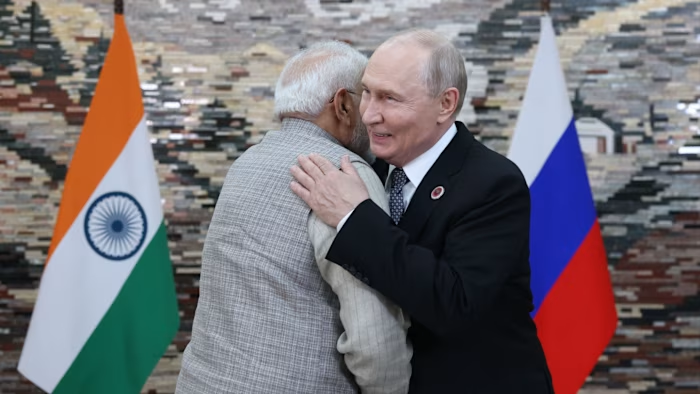
Putin arrived in New Delhi early on Friday, making his first in-person appearance at a Brics summit outside Russia since Moscow’s full-scale invasion of Ukraine in 2022. He was due to meet Indian Prime Minister Narendra Modi on Friday afternoon, as well as the leaders of Ethiopia, Malaysia and South Africa among others, the Kremlin said.
The newly expanded Brics bloc has 10 full members, including Indonesia and Iran, plus 10 “partner nations” ranging from Belarus to Vietnam. Saudi Arabia has been invited as a full member but has yet to formalise its accession. Heads of international organisations such as the UN, the World Trade Organization and the World Health Organization are expected to attend.
“One should converse only with the virtuous, act in concert only with the virtuous,” Modi wrote on X ahead of the two-day summit. “One should engage in debate and friendship only with the virtuous, and nothing whatsoever with the unvirtuous.”
The Kremlin is portraying the summit as an opportunity for Putin to project his influence after sharply curtailing his international travel since the invasion of Ukraine.
The Russian president skipped Brics meetings in 2023 and 2025 after the International Criminal Court indicted him on war crimes charges. He has only made three foreign trips this year, to China and central Asia.
Kremlin spokesperson Dmitry Peskov told state television on Friday that Putin and Chinese leader Xi Jinping would meet on the sidelines of the summit but would not hold a full bilateral meeting.
Peskov separately told Indian media this week that the sale of Russian SU-57 fifth-generation stealth fighter jets was on the summit agenda, as well as talks on new nuclear power plants for India. Modi and Putin were “in very close personal contact” and “are very pragmatic in their relationship”, he added.
The two countries also jointly produce the BrahMos supersonic cruise missile, which New Delhi fired in last year’s conflict with Pakistan and is now selling to the Philippines with Moscow’s approval.
Ajay Bisaria, a former diplomat who headed the Russia desk at India’s foreign ministry, said the Brics summit offered Putin “a great opportunity to be seen on a global stage in a much friendlier environment”.
“Almost all these non-western countries are sympathetic to Russia to some extent as the global south,” he said, though he added that “all of them want this [Ukraine] war to come to an end.”
Russia is a top oil and fertiliser supplier to India. New Delhi has sharply increased imports of both products this year to make up for shipments cut off by the US-led war on Iran.
India bought a record amount of more than 2.6mn barrels of Russian oil a day in June and July, up from 1mn b/d in February and accounting for more than half of the country’s crude imports, said Sumit Ritolia, lead India analyst at trade consultancy Kpler.
Indian trade minister Piyush Goyal has called on both nations to boost bilateral trade from $60bn annually to $100bn by 2030. Russia could buy more pharmaceutical products, car parts and food products from India, while Moscow could manufacture more in India, he said in a speech on Thursday to an India-Russia trade fair.
India and Russia have a close relation that dates back to the cold war. Since the turn of the century, they have held annual leaders’ summits — the latest of which Putin attended in December in New Delhi — and are fast-tracking a bilateral investment treaty, with some 40 investment projects already under way.
Bisaria said efforts to expand non-oil trade between India and Russia faced steep obstacles because of western sanctions and a lack of Russian capital, but New Delhi saw its relationship with Moscow as a valuable strategic hedge.
“Given that China is the primary strategic rival, what India is attempting is a tactical accommodation with China and closer relationships with both China’s closest strategic partner, Russia, and China’s systemic rival, the US,” he said.
