
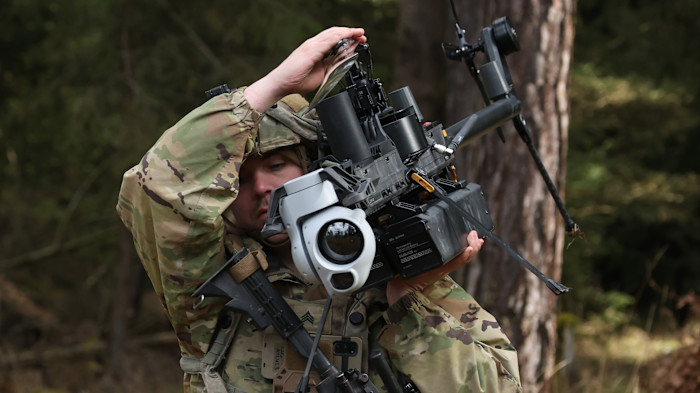
Investors are pouring billions into defence technology start-ups as wars in Ukraine and the Gulf turn drones, autonomous vessels and battlefield AI into one of this year’s hottest venture capital bets.
Companies in the sector have raised $12.3bn from VC funds since the start of 2026, almost double the amount raised in the same period last year and more than the $9.95bn achieved in the whole of last year, according to data compiled by PitchBook for the FT.
The surge comes as conflicts expose demand for next-generation weapons systems that are cheaper and faster to produce. However, with some funds willing to pay increasing multiples as they bet heightened government defence spending will endure, it has also raised concerns that parts of the market are overheating.
“We’re seeing the most important change in the way wars are being fought arguably ever,” said Daniel Rudnicki Schlumberger, head of JPMorgan’s security and resiliency initiative for Europe, the Middle East and Asia, adding that valuations had risen steeply as investors realised that “this is a sector with a long-term need.”
The Gulf conflict has also sharpened interest in maritime defence tech. UK start-up Kraken Technology, whose autonomous minehunting vessels have been picked by the Royal Navy for deployment in the Strait of Hormuz, is seeking to raise about $100mn at a roughly $1bn valuation, said people familiar with the matter.
The company is working with advisers at PJT Partners on the process, the people said. Kraken and PJT declined to comment.
Shonnel Malani, managing partner at private equity group Advent International, said that while there were “very valid” concerns over some of the higher valuations, the drivers underpinning demand would remain even once today’s conflicts ended.
Advent in March announced it planned to deploy up to $1bn into next-generation defence technologies.
“The underlying driver of why we need defence technologies and these defence capabilities . . . is very real. That is not a hype,” said Malani. “There is a more sophisticated set of technologies that could be used against us and we have to rise to that challenge.”
Thomas Preuss, chief investment officer for the defence tech fund of investment group DTCP, said that while the market was “super busy”, it was only overheated in corners of the sector such as aerial drones, with opportunities remaining in areas such as autonomous maritime systems and satellites.

The boom is heavily concentrated in the US. American start-ups captured $11.4bn of the total — although Anduril Industries accounted for almost half of that.
The Silicon Valley-based company, known for its drones and surveillance towers, almost doubled its valuation to $61bn in a $5bn funding round last month, with backers including Thrive Capital and Andreessen Horowitz.
Other US start-ups to have raised capital include autonomous surface vessel specialist Saronic Technologies and aerial drone maker Shield AI.
European defence tech start-ups have completed rounds this year worth $460mn, according to the data, although the figure excludes several large financings that are not complete.
The FT in May reported that Helsing, the German drone start-up backed by Daniel Ek, was raising $1.2bn at a valuation of about $18bn. Fellow German group Stark is also in talks to raise at least €300mn, valuing the maker of “kamikaze” drones at about €2.5bn.

“It’s a hot market . . . we are addressing what corresponds to the long-term budgets of European armies,” said Benoit Fosseprez, a general partner at investment group AVP, which recently launched a new €500mn European defence tech fund alongside VC firm Earlybird.
Companies involved in space technology are also excluded from the figures. Iceye, the Finnish-Polish maker of satellites, raised €1bn this month at a valuation of €10bn, four times the figure after its previous capital raise in December.
The jump in valuations has drawn investor scrutiny, adding to concerns that the sector has entered a “hype cycle”. One VC executive said there were questions over the sustainability of some companies’ revenues if the war in Ukraine ended.
But Florian Heinemann, founding partner at Project A Ventures, said valuations “don’t seem to be crazy — there is substantial business behind those companies and substantial order intake”.
Mikolaj Firlej, general partner and co-founder of Expeditions, one of Europe’s biggest venture capital funds focused on defence tech, said the region had “serious capability gaps”, particularly in areas such as intelligence and surveillance. He added the continent was also short of “local manufacturers of various critical components”.
The first investment wave was about “rebuilding Europe’s arsenal for the battlefield”, Firlej said. “Now it’s about securing the supply chain . . . from the frontline to the chips that make everything run — whether it’s sensors, electronic warfare, frontier AI models. Europe must stand on its own two feet.”
