

Close Menu

    Subscribe to Updates

    Get the latest creative news from FooBar about art, design and business.

    What's Hot

    Mitsubishi Motors recalls over 108,000 vehicles in the US over liftgate issue

    April 24, 2026

    Cohere to acquire German AI company Aleph Alpha

    April 24, 2026

    Assisted dying bill to run out of time as Lords hold final debate

    April 24, 2026
    Facebook X (Twitter) Instagram
    Addison Markets
    • Home
    • USA
    • Europe
    • Business
    • Investing
    • Tech
    • Politics
    • Contact Us
    Addison Markets
    Home»Tech»We still don’t have a more precise value for “Big G”
    Tech

    We still don’t have a more precise value for “Big G”

    franperez66q@protonmail.comBy franperez66q@protonmail.comApril 24, 2026No Comments2 Mins Read
    Facebook Twitter Pinterest Telegram LinkedIn Tumblr WhatsApp Email
    Share
    Facebook Twitter LinkedIn Pinterest Telegram Email


    The gravitational constant, affectionally known as “Big G,” is one of the most fundamental constants of our universe. Its value describes the strength of the gravitational force acting on two masses separated by a given distance—or if you want to be relativistic about it, the amount a given mass curves space-time. Physicists have a solid ballpark figure for the value of Big G, but they’ve been trying to measure it ever more precisely for more than two centuries, each effort yielding slightly different values. And we do mean slight: The values vary by roughly one part in 10,000.

    Still, other fundamental constants are known much more precisely. So Big G is the black sheep of the family and a point of frustration for physicists keen on precision metrology. The problem is that gravity is so weak, by far the weakest of the four fundamental forces, so there is significant background noise from the gravitational field of the Earth (aka “little g”). That weakness is even more pronounced in a laboratory.

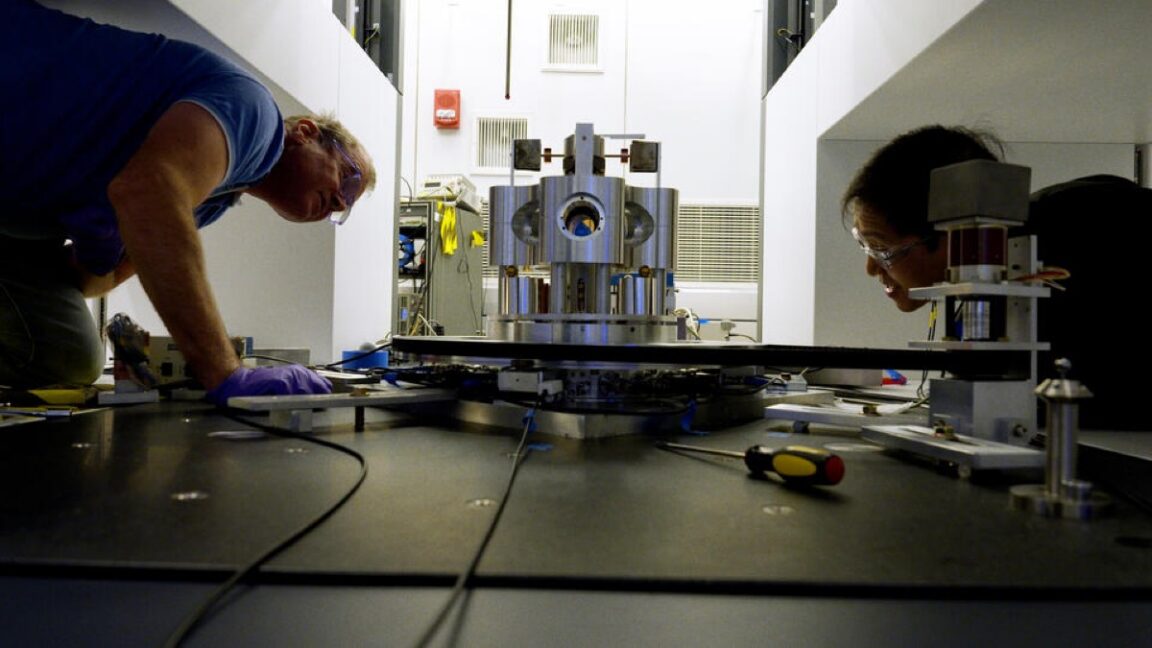
    In the latest effort to resolve the issue, scientists at the National Institute of Standards and Technology (NIST) spent the last decade replicating one of the most divergent recent experimental results. The group just announced their results in a paper published in the journal Metrologia. It does not resolve the discrepancy, but it gives physicists one more data point in their ongoing quest to nail down a more precise value for Big G.

    Isaac Newton introduced the concept of a gravitational constant when he published his law of universal gravitation in the late 17th century, although it didn’t get its Big G notation until the 1890s. Newton thought it might be possible to measure the strength of gravity by swinging a pendulum near a large hill and measuring the deflection, but he never attempted the experiment, reasoning that the effect would be too small to measure. By 1774, the Royal Society had established a committee to determine the density of the Earth as an indirect measurement of Big G, using a variation of Newton’s pendulum concept.


    Source link

    Share. Facebook Twitter Pinterest LinkedIn Tumblr Email
    franperez66q@protonmail.com
    • Website

    Related Posts

    Cohere to acquire German AI company Aleph Alpha

    April 24, 2026

    Alibaba’s Qwen AI is coming to cars, allowing drivers order food and book hotels by voice

    April 24, 2026

    Carbon nanotube wiring gets closer to competing with copper

    April 24, 2026

    Texas Instruments stock soars on Q1 earnings as AI demand jumps

    April 24, 2026

    Visitors to this private space station won’t be wearing shorts and T-shirts

    April 24, 2026

    Cramer says look to these 4 stocks to go with your high-flying tech names

    April 23, 2026
    Leave A Reply Cancel Reply

    Top Reviews
    Editors Picks

    Mitsubishi Motors recalls over 108,000 vehicles in the US over liftgate issue

    April 24, 2026

    Cohere to acquire German AI company Aleph Alpha

    April 24, 2026

    Assisted dying bill to run out of time as Lords hold final debate

    April 24, 2026

    American Airlines CEO: United merger would be ‘bad for customers’

    April 24, 2026
    © 2026 All right reserved
    • About Us
    • Privacy Policy
    • Terms & Conditions
    • Disclaimer

    Type above and press Enter to search. Press Esc to cancel.