


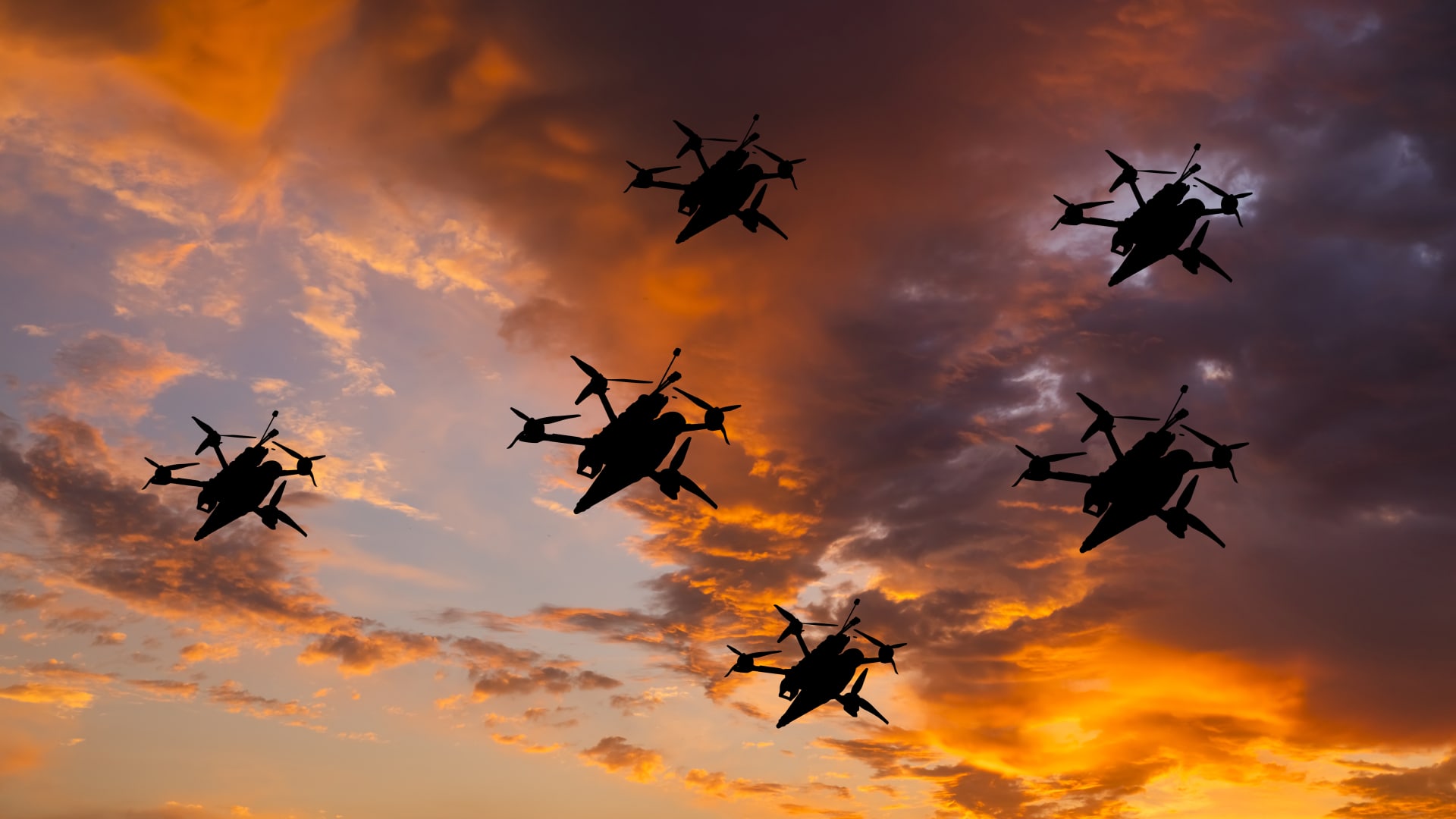
Anton Petrus | Moment | Getty Images
Europe has spent years rebuilding its military in response to Russia’s invasion of Ukraine. Now, investment is increasingly converging around one technology that is seen as central to the continent’s future security: drones.
A flurry of announcements over the past two weeks shows just how quickly that shift is accelerating. NATO unveiled a new drone initiative, the U.K. earmarked billions of pounds for drones and counter-drone systems, Germany moved to procure 50,000 drones for Ukraine, and defense tech startup Helsing secured an $18 billion valuation.
The developments reflect a broader shift in military planning, with drones and autonomous systems moving from niche battlefield tools to a core part of modern warfare. The trend is creating opportunities not only for drone manufacturers but also for companies developing AI, software, electronic warfare and secure communications.
“Future defence is moving towards a layered battlefield, where, for example, a tank will not simply fire shells; it will also launch drones, receive live targeting data from satellites and [unmanned aerial vehicles], share information across the battlefield, and operate as part of a networked force,” Morningstar analyst Loredana Muharremi told CNBC.
Battlefield lessons from Ukraine – alongside Iran’s use of low-cost Shahed drones in the Middle East – have shown the importance of relatively inexpensive, AI-enabled drones that can gather intelligence, extend the reach of conventional weapons and increasingly operate autonomously.
How are drones being used in modern warfare?
Those battlefield lessons are now reshaping procurement decisions across Europe.
Last week, NATO Secretary General Mark Rutte said the military alliance would become “drone-ready,” as he announced a drone initiative in which allies would invest more than $40 billion in counter-drone capabilities over the next five years.
Drones have “fundamentally altered” the character of modern warfare and have become a “decisive factor” on the battlefield, Rutte said, citing the Russia-Ukraine war as one example.
The U.K. is also investing heavily in autonomous systems. Under its Defence Investment Plan published in late June, the government committed £5 billion ($6.7 billion) to a “UK drone transformation” program aimed at strengthening the country’s armed forces.
Germany, meanwhile, is expanding support for Ukraine. On Monday, defense software company Auterion and Ukrainian drone maker Skyfall announced a 90-million-euro order for 50,000 drones equipped with Auterion’s operating system from a European NATO member. A source familiar with the matter confirmed to CNBC that the country was Germany.
“This is the first war happening at a time where drones were prevalent enough that they started to play a role,” Auterion CEO Lorenz Meier told CNBC.
Software is increasingly defining the battlefield, according to Meier.
Auterion’s operating system enables drones to continue striking targets despite electronic jamming, making them more effective in contested environments. “It allows them to dive into a target, even if the target has jammers, where previously they would have lost video signal and missed,” Meier said.
It also allows them to strike a target that’s below the radio horizon, for example, when a drone descends in a valley. The company plans to introduce software that allows operators to control coordinated swarms of drones rather than piloting each aircraft individually.
Fire at Omsk oil refinery as the region’s governor says the province came under attack from Ukrainian drones, in Omsk, Russia July 6, 2026, in this picture obtained from a social media video.
Reuters
While the latest order is intended for Ukraine, Meier said the technology is already attracting interest from armed forces, including those of Germany, Norway, Britain, and France.
Low-cost drones are also increasingly being paired with high-end weapons to improve their effectiveness by distracting or overwhelming enemy air defenses.
Beyond drone makers
The growing use of drones and other autonomous systems is also boosting the demand for the technology needed to coordinate the drones in real time, according to Muharremi. That includes secure communications, battle management software, AI, and satellite-based intelligence, sensors and electronic warfare systems.
“As a result, companies with physical platform scale and exposure across autonomy, air defence, sensors, electronic warfare, software, and space are likely to capture a share of future defence spending,” she said.
It comes as European core defense spending has doubled since 2019 and, under NATO’s 3.5% target for 2035, could reach about 800 billion euros by 2030 – roughly 2.9 % of GDP – according to McKinsey.
Among the biggest beneficiaries is Munich-based Helsing. On Monday, the company announced a funding round that valued it at $18 billion, cementing its position as one of Europe’s best-funded defense technology startups.
Helsing makes drones and underwater surveillance weapons, and builds AI and autonomous software to power these military applications, highlighting how Europe’s defense industry is increasingly betting that the future of warfare will depend as much on software and autonomy as on traditional military hardware.
