
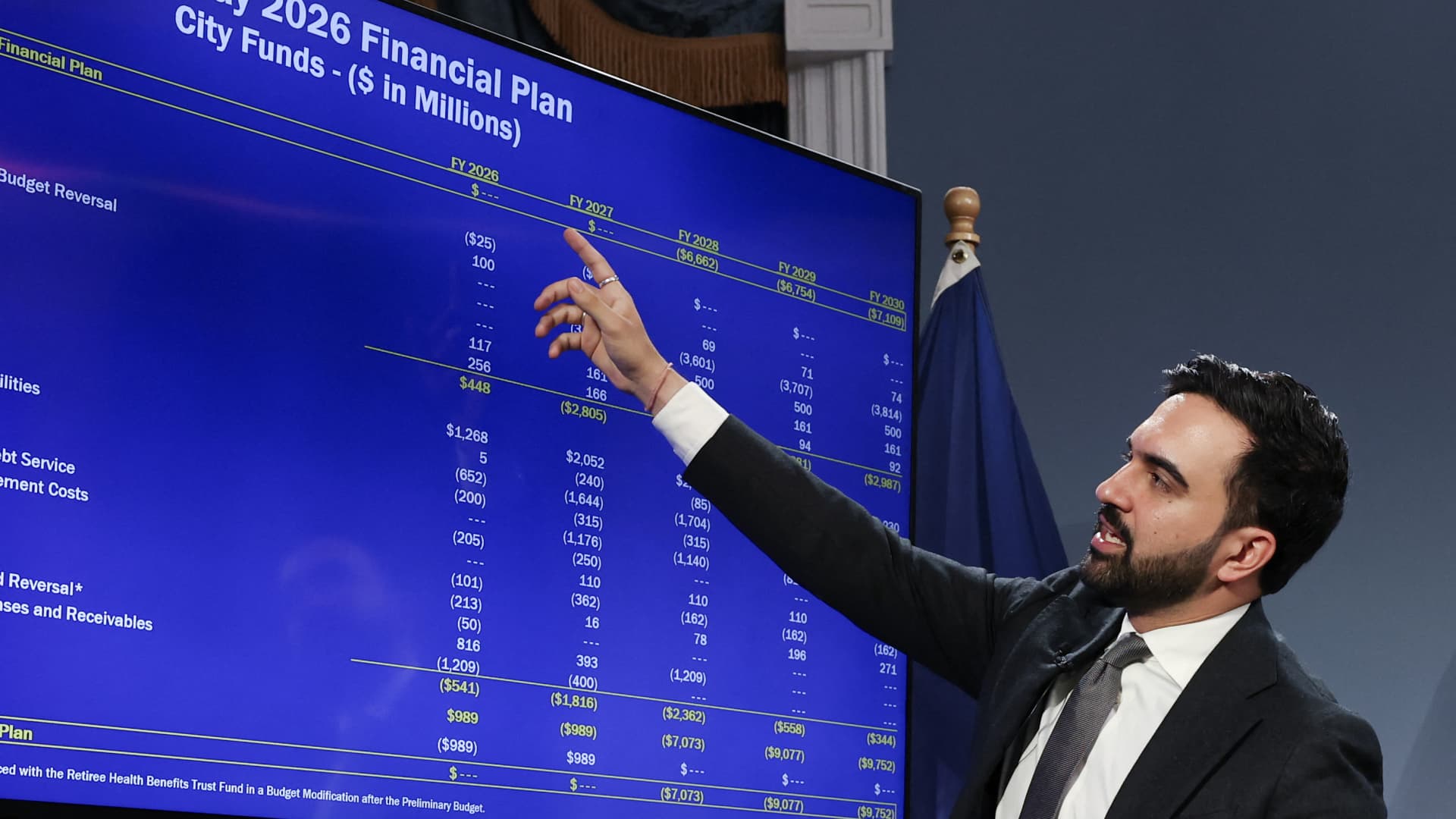
New York City Mayor Zohran Mamdani speaks about the fiscal year 2027 budget in New York City on May 12, 2026. (Photo by TIMOTHY A. CLARY / AFP via Getty Images)
Timothy A. Clary | Afp | Getty Images
From New York to Vancouver to London, a once-niche policy idea is moving into the mainstream of urban finance: taxing pied-à-terre properties, second homes, vacation apartments, and luxury units that sit partially or entirely unused.
New York City is just the latest example, with Mayor Zohran Mamdani and New York State Governor Kathy Hochul supporting the tax as part of a state and city effort to make up a big budget hole. In a new budget proposal this week, Mamdani dropped plans to raise property taxes on many middle-class homeowners, a move that could have been a difficult one for Mamdani to politically stomach, but kept the pied-à-terre tax idea.
The idea has already resulted in a political crisis for the mayor after he posted a video standing outside the building where hedge fund billionaire Ken Griffin owns a unit, leading to well-known politically conservative Griffin’s first vocal pushback against Mamdani, and a threat to pull business from New York in the future. While that’s a tension that has been expected to percolate between the billionaire class and new socialist democratic mayor, real estate sales in the city remain strong.
But there is a more fundamental question about this new form of property tax for New York to now contend with: does it work? There are existing examples from around the world to help in trying to answer it.
Versions of second-home and vacancy taxes exist globally, across several major housing markets. In Canada, Vancouver’s “empty homes tax” and a federal “underused housing tax” are among the most prominent examples. Toronto recently followed with its own vacancy levy.
As housing affordability worsens, rents continue to rise, and fiscal pressures mount, cities are increasingly targeting what are often highly visible symbols of inequality: dark luxury condos in prime urban neighborhoods.
Vancouver officials framed the city’s Empty Homes Tax as an attempt to “return empty or under-utilized properties to use as long-term rental homes for people who live and work in Vancouver,” according to the City of Vancouver’s public materials on the program. The city has also said net revenue from the tax is reinvested into affordable housing initiatives.
In Europe, London and Paris both apply forms of surcharge or higher taxation on second residences and underused properties. Singapore imposes some of the most aggressive foreign buyer surcharges globally, reaching as high as 60% in certain cases.
‘Vacant homes’ taxes and homeowner behavior
Paris is now moving toward even steeper vacancy penalties. According to reporting by Le Monde, the city plans to sharply increase taxes on vacant housing, with local officials hoping to push thousands of units back onto the market. Jacques Baudrier, Paris deputy mayor for housing, told the paper: “We hope that at least 20,000 homes will return to the market as a result.”
At the same time, Paris officials have acknowledged the limits of the policy. A 2025 report from France’s Cour des Comptes found that despite broader vacancy taxes and higher rates, the measures “do not appear to have had a significant effect on the overall number of vacant homes.”
According to Thomas Brosy, senior research associate at the Urban-Brookings Tax Policy Center, these policies generally fall into two categories: recurring property tax surcharges and one-time transaction taxes. The distinction matters, he said, because “it affects how strongly owners adjust behavior over time.”
The New York proposal is an annual tax on non-resident second homes worth $5 million or more.
An important distinction, in contrast to the New York law which targets properties worth $5 million or more, is that many cities impose the charges without specific regard to the price of the property: “In general, these policies tax homes based on occupancy or ownership status, not necessarily on the property’s value or the owner’s income or wealth,” Brosy said.

“Anti–second home policies” are well established around the world, according to Paul Cheshire, professor of economic geography at the London School of Economics. “New York is a follower, not a leader,” he said. But Cheshire argued that policymakers often misdiagnose the problem: “The biggest misconception is that these taxes will improve housing affordability in large ‘super cities.’ The problem is mainly constrained housing supply via policy,” he said.
Cheshire also noted that in many places, second homes remain a relatively small share of total housing stock, something he viewed as potentially limiting the potential scale of any tax. “Even in communities with high concentrations of second homes, it is still only around 15% of the housing stock,” he said, suggesting the taxable base is structurally constrained.
Brosy says the empirical evidence from cities like Vancouver and Paris backs up that view. “They raise some revenues and lower vacancy, but they don’t lower rents or prices overall — which should be expected, since the luxury housing market is largely disconnected from the broader housing market.”
One of the most consistent findings among experts is that these taxes generate far less revenue than policymakers initially expect. Global trends may be instructive in predicting the revenue the New York tax may end up generating. New York is expecting as much as $500 million, but that number may prove to be optimistic, according to Brosy.
New York City’s comptroller has some doubts
Mamdani said in an announcement on Tuesday that New York’s first-ever pied-à-terre tax “will generate $500 million every year.”
But New York City’s own comptroller recently issued a report saying that while the Vancouver data does show a notable decline in vacant homes in the years since that tax was implemented, its revenue projections for New York have to include the potential for a much lower take than the $500 million estimate put forward. While as much as $510 million is possible, a $340 million to $380 million estimate may be more realistic “after accounting for properties that could be already rented to primary residents and for the behavioral changes that have followed taxes imposed elsewhere.”
The comptroller’s report added that even higher taxes could have a larger behavioral effect.
“Behavioral responses to the tax — conversions to rental, primary-residence claims by relatives, sales, and possible legal challenges — introduce further variability that will only become observable after implementation,” the report said. “For these reasons, the additional tax should be incorporated into the City’s financial plan with a prudent revenue assumption.”
The comptroller’s report suggested that one impact on real property transactions could be initially positive if there is a wave of sales to avoid the tax. But it went on to say, “Broad effects on development or rents … have generally not been significant. However, concentrated effects on the luxury market could be felt more deeply, as suggested by London’s experience.”
London’s policy has been pointed to as a cautionary tale.
Abir Mandal of the Tax Foundation, generally viewed as a center-right think tank, says the revenue potential depends heavily on design and enforcement, but even then remains modest relative to housing needs. From the existing pattern across numerous global cities, Mandal said the takeaway is consistent: meaningful in absolute terms, but marginal in fiscal context.
Even in Vancouver, one of the most aggressive examples globally, and where vacancy rates did move substantially lower after the tax policy was implemented, vacancy-tax revenue remains relatively small compared with the overall scale of city finances. The Institute on Taxation and Economic Policy, found that Vancouver’s tax generated roughly 1% of total city tax revenue.
Mandal says empty homes can generate additional tax revenue without additional taxation from another perspective: their lack of drawing on public resources. “The biggest misconception is that these are ‘free lunch’ taxes on absentee ‘speculators’ or the ultra-wealthy that raise substantial revenue while improving affordability without economic costs. In reality, second homes, if unoccupied, impose lower marginal service costs (no additional pressure on police, schooling, etc.) while contributing to the tax base — making them net fiscal positives,” he said.
Potentially better politics than fiscal management
As to the politically-driven headline issue of whether such tax structures cause mass migration of ultra-wealthy buyers, the evidence globally doesn’t suggest that any single tax policy change will have that effect. The consensus among experts is that second-home taxes influence marginal decisions but rarely determine whether wealthy individuals invest in global cities. Brosy described the effect as incremental rather than decisive: “They should certainly shift demand and push prices downward for trophy properties, but they are unlikely to determine whether someone owns in London, New York, or Singapore,” Brosy said.
However, when combined with broader tax regimes, these tax policies may contribute to gradual shifts in where ultra-wealthy individuals allocate assets, particularly toward lower-tax jurisdictions. Policymakers in Europe and North America increasingly face competition from jurisdictions offering low or near-zero property taxation alongside residency incentives for wealthy investors. Dubai’s rise as a magnet for global wealth has sharpened those comparisons, at least before the start of the U.S.-Iran war, which could also have lasting implications.
Mandal pointed out that for the ultra-wealthy, it’s more a matter of cumulative impact rather than single policy: “Tipping points emerge from cumulative burdens rather than isolated surcharges,” he said.
Evidence from high-tax jurisdictions, such as California/New York to Florida/Texas migration waves, and UK changes prompting London exits to Dubai, indicate sensitivity among many demographics, not just the ultra-wealthy, including retirees, investment-income reliant individuals, and business owners. U.S. data shows millionaire migration to lower-tax states. A single NYC tax won’t empty Manhattan, but combined with existing high costs, it accelerates decisions for those with flexible footprints, “especially with many global cities providing a welcoming haven and strong passports,” Mandal said.
Politics is another story. The taxes remain highly attractive because they target a narrow and affluent slice of homeowners rather than broad middle-class property owners, as the New York case shows. The appeal of pied-à-terre taxes may ultimately lie less in their fiscal power than in their symbolism: they allow governments to be seen as responding to housing inequality without imposing broader tax increases on full-time residents.
