
Unlock the White House Watch newsletter for free
Your guide to what Trump’s second term means for Washington, business and the world
Russia’s invasion of Ukraine has led to the bloodiest war in Europe since 1945. The conflict between Iran, the US and Israel has seen 12 countries in the Middle East directly involved in fighting — making it the most widespread war in the region for decades. In east Asia, North Korea is pursuing a rapid military build-up and has renounced the goal of peaceful reunification with the South. Meanwhile, China has stepped up its naval exercises around Taiwan and seems to be rehearsing cutting off the island’s supply lines.
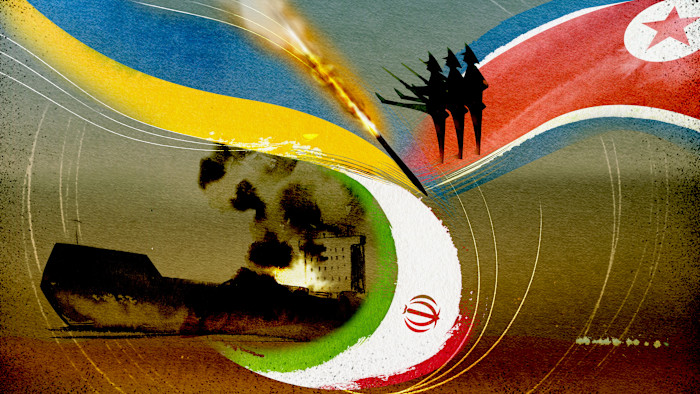
At present, these regional conflicts in Europe, the Middle East and Asia are largely distinct. But they are beginning to overlap. Over the weekend, Iran said that Ukraine had sunk an Iranian merchant vessel in the Caspian Sea, killing a sailor. The Ukrainians have acknowledged long-range strikes on Iranian ships in the Caspian, saying they were aimed at military cargo vessels heading for Russia. Volodymyr Zelenskyy has also just warned that North Korea is preparing to send another 30,000 troops to participate in Russia’s war on Ukraine.
When the initial deployment of North Korean troops arrived on the frontline in 2024, the Ukrainian president described their deployment as the “first step to a world war”. Now that the Ukrainians are clashing directly with Iran, it is arguable that a second step has been taken.
The first and second world wars, as their names suggest, took place on several continents at the same time. Both conflicts also involved identifiable global alliances. Between 1939 and 1945, the Axis powers of Germany, Italy and Japan faced off against an alliance centred around the UK, the US and the USSR. These two world wars also entailed direct conflict between the most powerful countries in the world.
The current set of conflicts already meets a few of these criteria. Overlapping wars now span two continents — Europe and Asia — and are influencing conflicts in Africa. The growing alignment between Russia, China, Iran and North Korea has led some strategists in the US to characterise those four countries as an “axis of adversaries” (or “axis of upheaval”).
However, Donald Trump’s often adversarial attitude to many of America’s traditional allies — as well as the fact that Israel is increasingly seen as a pariah state in Europe and parts of the Gulf — makes it harder to identify a unified bloc pushing back against the anti-American grouping.
Ukraine’s decision to take on Iran may be, in part, an attempt to create a more cohesive bloc to challenge the axis of adversaries. Any analysis of Kyiv’s motives has to be tentative, since the details of what is happening in the Caspian are disputed. But the Ukrainians have ample reasons to want to hit back against Iran — which has been supplying Russia with the Shahed drones that have killed a great many Ukrainians.
At the same time, Kyiv may see an opportunity to dramatically improve relations with the Trump administration by emphasising the extent to which Russia is helping Iran fight the US. Zelenskyy has already pointed to Russia’s provision of intelligence which Iran has used to target American troops and bases in the region. US efforts to blockade Iran are also hampered by the fact that Iranian goods and oil can cross the Caspian to Russia. Disrupting that route would help any American effort to collapse Iran’s economy.
The Ukrainians feel that they are slowly gaining the upper hand in their war with Russia. But the arrival of fresh troops from North Korea would clearly help Putin. Unfortunately, Kim Jong Un, North Korea’s despotic leader, has every incentive to aid the Kremlin — since Russia is providing North Korea with advanced technology and helping the Pyongyang regime break out of its economic and diplomatic isolation.
China’s aid to both Iran and Russia is more discreet. But close observers believe that it is nonetheless vital. Thomas Wright, who was senior director for strategic planning in the Biden White House, pointed out recently that “China has helped Russia rebuild its military capacity far more quickly than would otherwise have been possible, supplying machine tools, microelectronics, and other crucial technologies while co-operating on drone production”. The Chinese have also supplied Iran with “dual-use goods” — such as fuel that can be used for missiles and commercial satellite imagery.
There is no formal alliance between the “axis of adversaries”. But China, Russia, North Korea and Iran do share common aims. All four countries want to hasten the decline of American power and to dominate their neighbourhoods. China also has realistic aspirations to displace the US as the world’s most powerful country. The aspirations of a rising nation to replace the dominant global power have often led to war in the past, a phenomenon labelled the “Thucydides trap” by the Harvard academic, Graham Allison — and much discussed by Xi Jinping, China’s leader.
There is no doubt that both China and the US are actively preparing for war against each other. But both Washington and Beijing seem to be simultaneously trying to prevent their rivalry turning into outright conflict. That is encouraging — but it does not guarantee that another world war is impossible. As the history of the 20th century demonstrated, regional conflicts and great-power miscalculation can be a deadly combination.
[email protected]
