


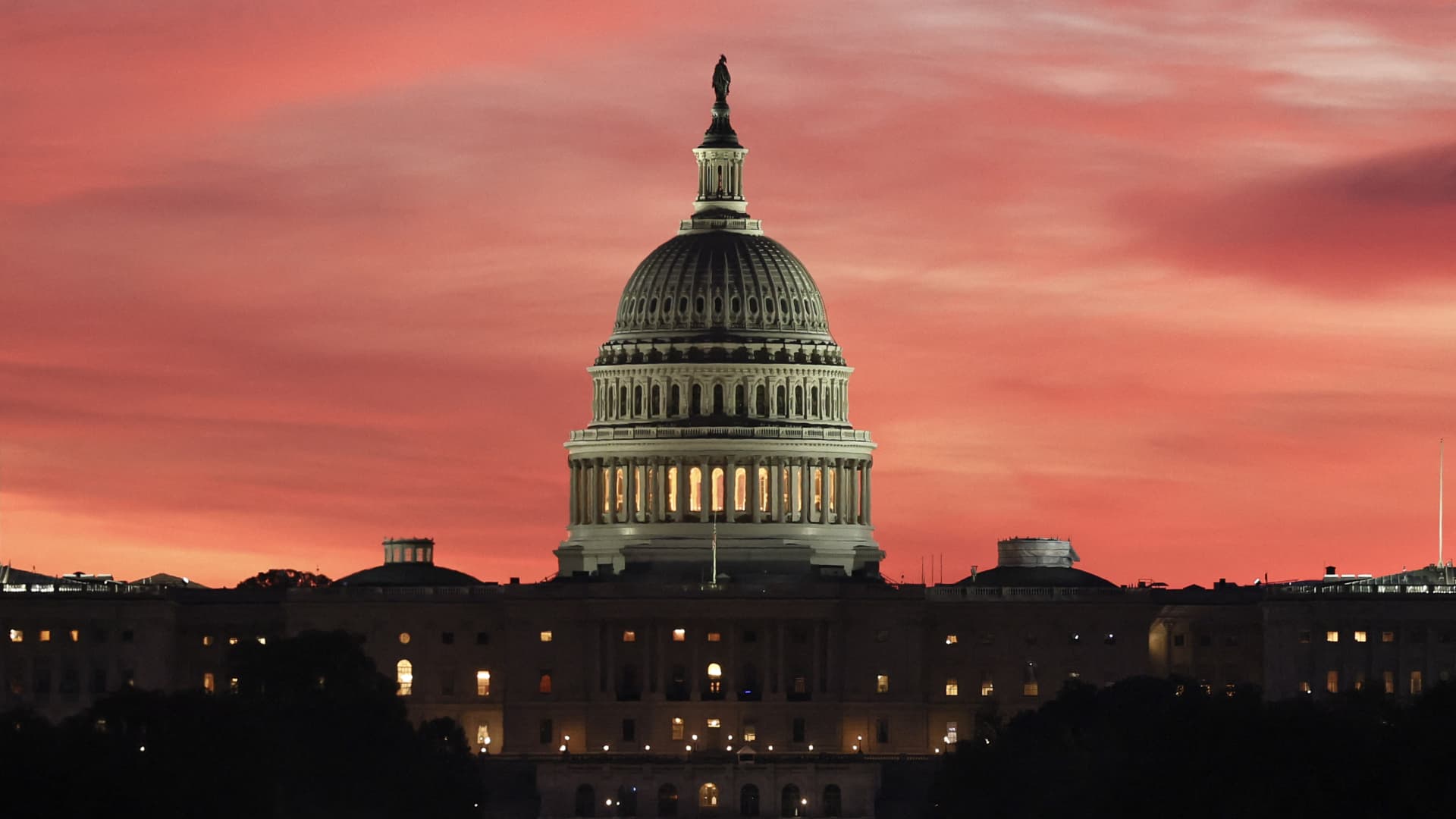
The rising sun illuminates the sky behind the US Capitol building in Washington, DC, on November 2, 2026.
Jemal Countess | Afp | Getty Images
Democrats’ sweep of Congress likely resets the political calculus for crypto, ushering in a more adversarial approach in Washington and pushing industry-friendly legislation like the Clarity Act to the back burner.
With crypto critics like Sherrod Brown (D-Ohio) returning to the Senate and Sen. Elizabeth Warren (D-Mass) retaining significant influence over financial policy, analysts say the new Congress is likely to focus on scrutinizing President Donald Trump’s personal crypto dealings over supportive industry legislation.
For years, crypto fought an uphill battle in Washington, asking for clear operating rules, but often landing on the receiving end of regulation by enforcement. That shifted after Trump’s 2024 election victory, giving the industry a reprieve and seat at the policy table.
“We see Sherrod Brown winning in Ohio as damaging the crypto industry’s political clout as the industry worked to defeat him,” Jaret Seiberg, TD Cowen’s Washington analyst, said in a note Wednesday. “We did not think Clarity could advance over the next two years. This makes us more confident in our prediction.”
The crypto industry spent more than $200 million to sway the midterms, hoping to get leaders elected that could push a comprehensive crypto market structure bill over the finish line after the Clarity Act stalled in the Senate.
Seiberg emphasized that Democrats “will investigate Trump’s crypto entanglements including World Liberty Financial” and said “the resulting political environment may make it impossible to advance a version of Clarity that the crypto sector could back.”
The stakes extend beyond market structure legislation via the Clarity Act, or another version of it. Stablecoin innovation, decentralized finance (DeFi) development, banking access, tokenization and sensible tax policy are priorities seen by the industry as important to ensuring the U.S. remains competitive in the global crypto economy.
The industry will need continued bipartisan engagement to ensure these priorities aren’t sidelined by changing political dynamics. And Democrats have historically been less supportive of crypto than Republicans, though that divide has narrowed as more Democrats embrace the industry.
The implications of Democrats’ big win aren’t all bad. Crypto has reached a level of financial integration that could be difficult to reverse, with its future increasingly centered on establishing crypto as financial infrastructure. Even with the CLARITY Act potentially stalled until 2028, key financial regulators can help advance the industry through rule-making.

Coinbase’s vice president of U.S. policy, Kara Calvert, points out that the election results point to a historic shift in the makeup of the incoming Congress, with a record number of pro-crypto voices expected to join its ranks.
“With last night’s results, the 120th Congress is on track to have more new pro-crypto members than we’ve ever seen in any freshman class,” she said. “Crypto is 100% bipartisan, and that’s why the future of finance does not rest on either political party or a single election night. Democrats and Republicans alike know that clear rules protect consumers and keep innovation in the U.S.”
As of Thursday morning, 19 candidates characterized as pro crypto by the advocacy nonprofit Stand With Crypto have been elected to the Senate versus eight Senate candidates it characterizes as anti crypto. In the House, 228 pro crypto candidates have been elected versus 106 the group deems anti- crypto.
Several races have not been called but Fairshake – the super PAC launched in 2023 to support pro-crypto candidates regardless of party – has so far won 29 of the 34 races it spent on, per Reuters, including three of the six House candidates it prioritized by spending a baseline of $1 million on their campaigns.
Dante Disparte, chief strategy officer and head of global policy and operations at Circle, emphasized Circle’s bipartisan approach and readiness for new Senate and House leadership.
“With this midterm election result, folks need to see that they have some equity in this process, that they have their interests represented in this process, and therefore it may take longer to get Clarity tabled again,” he said. “But I wouldn’t characterize it as bad – that’s been frankly too reflexive a response from industry and from other players … Crypto is purple.”
He also pointed to the Genius Act, the “roundly bipartisan” stablecoin legislation passed into law last year and set to take effect in January. The law is a significant policy advancement, he said, “that [the Democrats] will feel 1, ownership over and 2, recognition of, considering so many of them have been in the crucible of public policy debates on what good looks like.”
That bipartisan support may offer a blueprint for what comes next, but even if crypto legislation stalls, progress can continue, said Joseph Chalom, CEO of ether treasury company Sharplink.
“We expect the CLARITY Act to remain on hold through 2028. Even so, there is a clear path forward for stablecoins … and for the tokenization of public equities under the SEC’s five-year innovation exemption,” he said. “Technological progress is rarely rolled back. Once the benefits of faster settlement, lower costs and markets that never close become clear to investors and institutions, this shift will be very difficult to reverse, regardless of who wins the White House in 2028.”
