


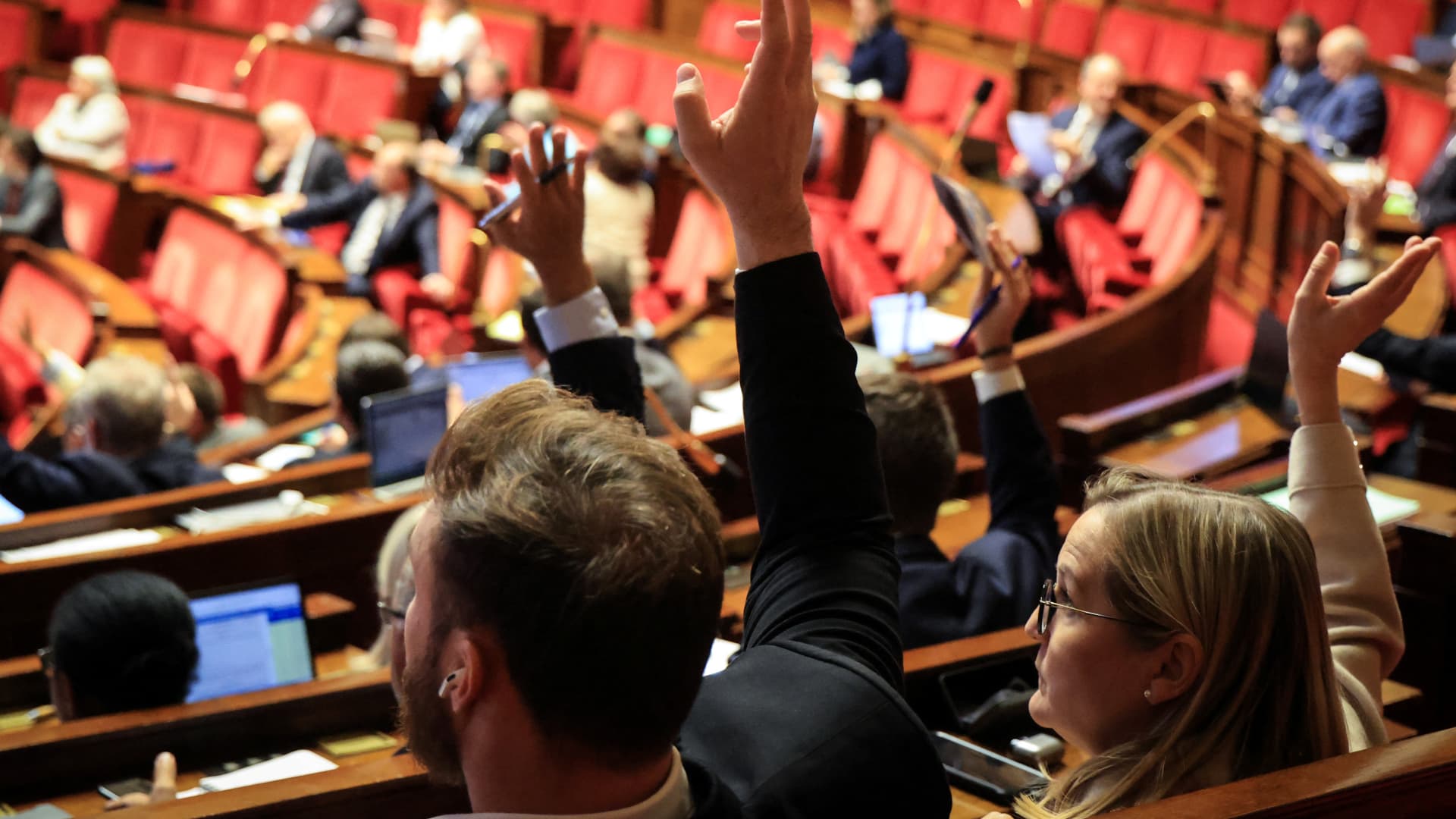
French right wing party Les Republicains MP Philippe Juvin speaks during a session at The National Assembly for the first-reading review of the 2027 state budget bill in Paris on Nov. 4, 2026.
Ludovic Marin | Afp | Getty Images
French lawmakers rejected the government’s cost-cutting budget on Wednesday evening, as the country’s finances fuel widespread protests and worry bond markets.
Politicians in the National Assembly — the lower house of France’s parliament — voted unanimously against adopting 2027 budget plans drafted by Prime Minister Sebastien Lecornu’s government.
The government is trying to appease France’s creditors — traders in its bonds — by drastically reducing the country’s deficit and convincing lawmakers to approve sweeping spending cuts.
Lecornu said in September that he was targeting spending cuts worth 54 billion euros ($61.8 billion).
But no one party holds a majority in the National Assembly and lawmakers across the political spectrum sit in it, making agreements on fiscal policy difficult.
Since 2024’s snap election delivered a hung parliament, successive governments have used Article 49.3 of the constitution to force budgets through without a vote.
But threats of motions of no confidence have previously forced concessions. If a government is ousted, lawmakers must go back to the drawing board with the budget.
Another option is to pass the budget by ordinance, which has never been done in the French Fifth Republic, created in 1958. If a government is ousted after using this power, the budget it forces through remains in place.
Lecornu secured the 2026 budget via Article 49.3, after replacing ousted Prime Minister François Bayrou.
Concerns about the French budget deficit, which measured 5.1% of gross domestic product in 2025, have seen French government bonds — known as OATs — come under extreme pressure this year.
With borrowing costs rising, the country’s national debt — which amounted to 115.6% of GDP in 2025 — is also increasingly a source of concern.
Widespread unrest
Since late September, France has seen violent protests across the country, with demonstrations dissolving into riots and looting in late October. What began with student protests over education funding is thought to have caused more than 1 billion euros ($1.1 billion) in damages.
Nationwide strikes were due to take place on Thursday, with hundreds of thousands of people expected to join demonstrations voicing discontent with the rising cost of living.
Protesters hold placards during a demonstration as unions hold strikes alongside student-led demonstrations in Nantes on Nov. 5, 2026.
Sebastien Salom-Gomis | Afp | Getty Images
Interior Minister Laurent Nuñez has said 70,000 police and gendarmes — a military police force — will be deployed in efforts to quell any outbreaks of violence.
French media reported on Thursday that fires had been started at some demonstrations, with protesters spotted carrying placards that read “no to a France held by markets,” while news agency Reuters reported tear gas had been fired at demonstrators in the city of Lyon.
‘No easy way out’
Analysts told CNBC that Wednesday’s rejection of the budget makes the French government highly likely to invoke special powers that allow legislation to be forced through without a parliamentary vote.
Mujtaba Rahman, managing director for Europe at Eurasia Group, told CNBC in an email on Thursday that the vote was “largely meaningless in the sense that there was never any chance of this divided National Assembly passing the budget in the normal way.”
“It arguably helps the government by giving them time to prepare to push through a budget next month by ‘other’ means, using special powers granted by the constitution,” he said.
Charlotte de Montpellier, senior economist for France at ING, agreed that the budget’s rejection was “not a surprise at all.”
“No one believed that they could have validated the budget because … the parliament is so fragmented. There was no chance,” she said on a call, adding: “In the end, the budget will need to pass without a formal vote.”
De Montpellier noted that the French press appeared convinced the government would use its ordinance powers to force next year’s budget into place — but said that the proposed measures were unlikely to deliver a drastic reduction in the deficit regardless of what comes next.
“It’s clear that in any case, the budget target will not be reached,” she told CNBC. “So even if we do see the draft budget [passed], we are not going to be at 5% of GDP next year. It’s impossible because the growth is so much weaker than expected. They would need even more savings, which is not going to happen. So the deficit will be higher than 5% for next year.”
The outlook for France is “quite bad,” de Montpellier told CNBC, pointing to low economic growth, falling confidence, and weakening domestic demand and investment — not to mention the unrest reaching boiling point across the country.
“There is no easy way out because the usual way out of protests in France is to buy social peace, that’s what has been done in the past,” she said. “You use more money, and then things go back to a more normal situation. But in this case, it’s a bit difficult to do that. So it’s likely that unhappiness or the feeling right now will remain a bit going forward.”
However, she added that France was not on the verge of “collapsing.”
“It’s a very difficult situation because all the news is bad, [but] it doesn’t mean that we are about to see the collapse of France. We are not in as big a debt as Greece [before the euro zone crisis]. It’s more like a very difficult phase, but France is not completely doomed,” de Montpellier said.
