

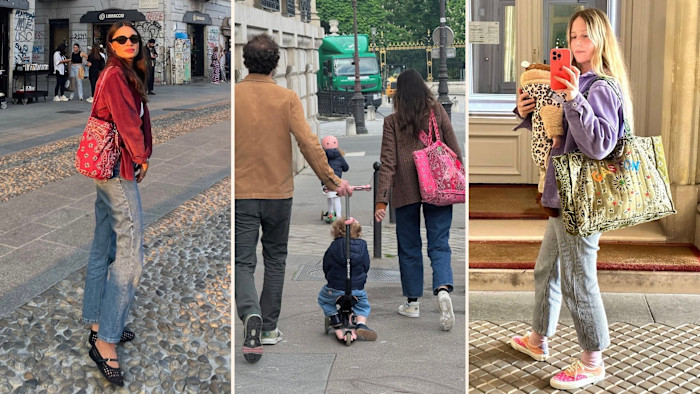
On a Saturday morning in the Jardin du Luxembourg, the lifeblood of Paris’s Left Bank, there is scarcely a cool French mother hovering before the merry-go-round without the same colourful item slung over her arm or the back of a pram. At the fabled Lagardère Racing tennis club in the Bois de Boulogne, you cannot swing a racket without hitting one either. Well-heeled Parisian women, long associated with a disciplined palette of neutrals, have made an exception to their style code: a €200 cotton tote in multicoloured, stitched bandannas, from the local label Call It By Your Name.
The bags come in bold primaries and, more often than not, carry first names appliquéd across the front in large rainbow lettering. Louis, Arthur, Ines, Ava, Marceau. The names are not those of the women themselves but of their children. And unlike these classic French names that are back in favour, the bags take a more visual detour: bandanna prints, dangling lucky charms, souvenir-like colours, and a deliberately playful, almost holiday-shop aesthetic that sits outside traditional Parisian restraint.
There is a broader shift underpinning this. During the past decade, Paris has absorbed a new rhythm: trendy oat-milk takeaway coffee shops, reformer Pilates studios and a more international cadence of consumption. Where London once held a strong position in Europe’s cultural capital, the post-Brexit period has coincided with a renewed draw to Paris, where European creative industry talents circulate more fluidly.

Yet the more telling evolution is not on the runway but in the everyday wardrobe. As Alexandra Van Houtte, founder of Tagwalk — a fashion search and data platform used by designers, buyers and editors to track trends — puts it: “You may have an expensive jacket, a sophisticated look, but you’re playing it cool by having something a bit fun, a bit cheaper on your arm. I also think it’s a way of showing that you have a family, with the names of your children on there.” The effect is to puncture the Parisian uniform without dismantling it; tailoring and denim offset by something lighter and more personal. In a city where discretion has long been a form of social currency, that shift is quietly significant.
For the brand’s founder, Parisian mother of three Colombe Campana, 44, the idea began with a gap in the market rather than a statement. “I couldn’t find a bag that was neither identified as a children’s bag nor as something purely for myself,” she says. “I wanted an object that could move between the two . . . while remaining stylish, distinctive and well made.” The result is a capacious, lightweight tote designed to accompany, rather than replace, a more formal handbag. The brand’s signature bandannas are produced in South Carolina, in one of the last remaining factories of its kind in the US, before the bags are assembled in Europe.
Its resonance, Campana suggests, reflects a broader reframing of motherhood. Once treated as a stylistic “parenthesis”, it is now integrated into how women dress and present themselves. Social media has accelerated visibility, but the shift feels more structural: “Motherhood is no longer set apart — it’s part of style and everyday life. The tote’s success is part of this movement.”
The early emphasis on personal customisation, including embroidery, colour combinations and names, established a direct relationship with customers; what is being sold is not only a bag, but a lightly coded narrative blending sentiment alongside utility.
Customisation requests are placed through the brand’s website before being hand-embroidered at its workshops. According to Campana, however: “American clients often pre-order their customised bags to pick up at Le Bon Marché when they arrive in Paris, or have them delivered to their hotels.” Even as ready-made versions have grown, bespoke orders still account for a meaningful share of sales, with American clients regularly purchasing $3,000 worth of customised bags several times a week, according to Campana. The brand’s Parisian client, while regular, will typically spend a more moderate €250 per order.
Campana describes the tote as a “Trojan horse”: a way of introducing a broader language of colour and informality. Her reference point is what she calls a “French American dream” — the meeting of Parisian precision with American visual culture. The bandanna, an object loaded with Americana, is reworked with a distinctly Parisian, no-nonsense sensibility: a hold-everything bag to throw one’s belongings into, then nonchalantly toss over the shoulder or buggy, and continue about one’s busy Parisian day.
The brand has found particular traction in the US, while maintaining credibility at home, aided by its strong presence at Le Bon Marché. For visiting Americans, it reads as a shorthand for contemporary Paris; for locals, a softer deviation from the norm. Six years on, the tote has become a staple. The task ahead, as the brand grows, will be maintaining that sense of personal authorship at scale.
Call It By Your Name has achieved something quite rare in Paris: a visible loosening of Paris style codes. As Campana suggests, the appeal lies not only in the bag’s graphic distinctiveness, but in the permission it gives women to make a small, proud aspect of private life visible to all, one name at a time.
‘Wear in the World’ is a new monthly Style column that looks at micro style trends in a particular city or place
Follow us on Instagram and sign up for Fashion Matters, your weekly newsletter about the fashion industry
