


Paul Ricard was a man of many passions. In fact, he titled his memoir A Passion for Creating, which ultimately sounds like an understatement. The founder of France’s most emblematic pastis, Ricard turned his aniseed aperitif into a juggernaut; his family’s company is one of the biggest spirits brands in the world. He loved to sail. He loved to paint. He built a racing track, Le Circuit Paul Ricard, which for 20 years hosted France’s F1 race. He founded an Oceanographic Institute set on the Mediterranean sea that, as a born-and-bred Marseillais, he adored. He bought two islands – three if you count a piece of land moored in the marshes of the Camargue.
Perhaps the most telling example, though, was his own living room. Ricard kept extending and extending it in order to accommodate the portraits of loved ones he would insist on painting; a never-quite-ending gallery reflecting his never-quite-ending urge to create.
Yet when asked what he would be remembered for, Ricard – who would die in 1997, aged 88 – replied: “Bendor will stay.”


Île de Bendor is an apt representation of Ricard’s relentless spirit. This small island, only 700m long and 200m wide, sits directly opposite Bandol, a discreet, unpretentious holiday town an hour’s drive east of Marseille. When Ricard bought it in 1950, it was an undeveloped rock, its sole inhabitant one lonely sheep. Before then, the only people to brave it had been pirates. Ricard set about creating a private residence for himself and his five surviving children, but also hotels, restaurants, shops and artisanal workshops, a diving club (loyalists say the first in France) and even, for a short time, a zoo. Ricard had been one of the first businessmen in France to give shares to all his employees; accessible to all, Bendor became a symbol of his gregarious paternalism.
“The idea was to create a destination, a miniature world,” says his great-grandson, Marc de Jouffroy. “It was his baby, his legacy, his money, his heart.”

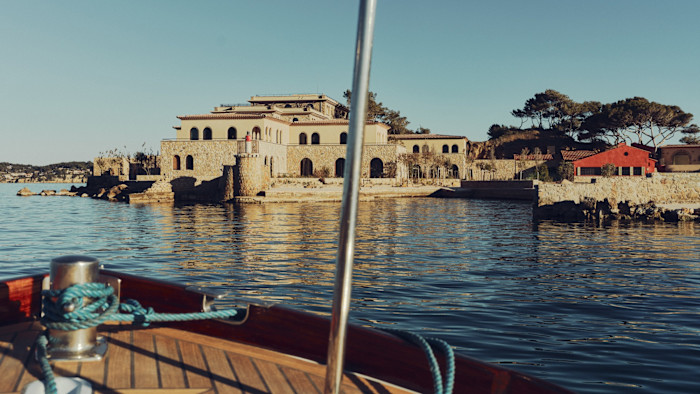
De Jouffroy is sitting in the lobby of Soukana, the hotel Ricard built on the far western tip of Bendor. If the bones of the building haven’t much altered – an austere façade facing Bandol on one side and an unending white-blue sea on the other – everything inside is changed. Bendor has just gone through a vast overhaul. In the years following Ricard’s death, it got “tired”, as de Jouffroy puts it, neglected and even partly abandoned. For nearly two decades Soukana was a kind of haunted house where local kids would come and play.
De Jouffroy, an affable, slightly bearish man in his early 40s, found this particularly painful; he holidayed on the island every year, like all his cousins, and even got married on it. He remembers his great-grandfather, who died when de Jouffroy was 12, very clearly. So he has spent the past five and a half years working on a huge gamble. With the support of his extended family (who all remain co-owners of the island, just as they are all still actively involved in the business), he has turned Bendor into a five-star luxury resort.


“It was a project that seemed utopian to some; quite mad, but totally ambitious,” he says. “To ask, how do we respect the identity of our island, based on simplicity, refinement, art and conviviality? But at the same time, how do we elevate it, to gain a much more international clientele?”
To this end, the island is offering what he calls “the atmosphere of a Mediterranean village”. The new arrangement provides three restaurants, a café, an ice-cream shop, a crêperie; also an “artist’s village”, a row of houses on the island for seasonal residencies. True to Ricard’s love of art (he was friends with Salvador Dalí, who visited the island), some 300 works by contemporary artists are being dotted around the complex. All are for sale (once one is sold, it will be replaced by another work by the same artist). There is a sizeable new wellness centre where, on arrival, your “energies” will be assessed and addressed. There is a kayak club, the diving club and the option of going on a fishing expedition – although this experience will be so authentic you will have to get up at 3am to take part in it.
“There are those who are happy to just go to the Maldives or the Bahamas, and to have a beautiful room,” says de Jouffroy. “In addition to a beautiful room, we offer that extraordinary thing – an extra bit of soul.”


Suitably, for such a family enterprise, de Jouffroy is managing this via what he calls a “marriage”. Arnaud Zannier, with his group Zannier Hotels, is the spouse. The son of multimillionaire entrepreneur Roger Zannier (who made his fortune from French high-street fashion brands such as Kickers and Chipie), he has spent the past 15 years developing six unique hotels across the French Alps, Namibia and Cambodia. A raffish presence with wavy hair and dusty, hard-worn boat shoes, Zannier won the Bendor redevelopment contract from a tender sent out to 15 major hospitality groups. He was the outsider; de Jouffroy had never heard of him. Yet after a two-hour tour of the island together, de Jouffroy had made his decision: “To my great surprise, I immediately understood it would be them.”

Zannier offers what he calls a “humble approach to luxury”, which might be best summed up as discretion in everything – service, decor, entertainment – but framed in the unmistakable language of wealth. Most importantly, he understands the Ricards’ unique point of view. “The Ricard family has a very humble DNA,” he points out. “Pastis Ricard is often the cheapest alcohol you can get on the menu.” A visitor, he says, “could be just a small family coming to get an ice cream on the port, staying two hours on the island, shopping, looking at the art gallery. Or it could be an American who’s going to spend $50,000 for a week.”
“There were several big, well-known hoteliers that, as soon as they heard our plan, said, ‘We won’t come,’” says de Jouffroy. “Because they wanted to make the island entirely private, and they didn’t want people to come in from the coastline. Well, fine, but that’s not our vision.”


Bendor is only a seven-minute boat ride from the mainland, and much of that is taken up by looping through Bandol’s port. It also truly is small. While it looms impressively from afar, as you get closer it looks more and more like a toy town, a row of miniature, multicoloured, Provençal-style houses lining the harbour. But “there are lots of different places on the island, lots of different atmospheres”, promises de Jouffroy. “Every time you go for a walk, you encounter a different element.” This is partly due to Paul Ricard’s knack for building; a variety of distinctive structures proliferate through the place. “He did it with his instinct, his desires of the moment,” says de Jouffroy. “That passion for creating. It’s almost compulsive.” One of Ricard’s first constructions ended up leaning, as it was built on flimsy foundations. “But that didn’t matter,” shrugs de Jouffroy. “That was Paul Ricard too.”
Much of this project has been a delicate dance between preserving the spirit of Ricard’s Bendor while preparing it for 21st-century luxury tourism. There was a need for what de Jouffroy calls “architectural cohesion”. The bulk of the structures remain, sensitively renovated, but the leaning tower has gone, as have a plethora of faux Greek and Roman columns that Ricard had grafted onto various façades. “We took some nice photos, to remember,” says de Jouffroy. “Then we moved on.”


The 93-key Zannier Île de Bendor hotel complex is in fact two and a bit hotels: the 49-key Soukana to the west, the 39-key Delos to the east, and five former fishermen’s houses, with gardens, near the harbour. While Delos speaks more directly to Bendor’s first heyday, all graphic ’60s stripes and vintage midcentury furniture, Soukana now has a distinctly post-Axel Vervoordt vibe. A suite is decorated in muted, earthy colours, the bathroom is reassuringly large and the walk-in wardrobe houses exercise kit made by Méditatif, the brand founded by Zannier’s wife. A second’s walk away is the wellness centre. A former museum that once held Ricard’s collection of hundreds of old drinks bottles has been demolished to make way for a slightly Moorish-style spa.
Luxury is often required to be simple (or at least to seem simple), and it is often asked to be community-minded, in harmony with its surroundings. These are the guiding tenets of all of Zannier’s projects. Yet he admits that “the challenge [with Bendor] is going to be making sure that everybody’s happy on the same island, living different experiences”.

He is confident, however, that there is a market for it. “We’ve had very wealthy people as our customers at Zannier Hotels, from Jeff Bezos to all those guys,” he says. “But they know why they’re staying with us, and this is what they’re looking for. You have people looking for simplicity – local community, local culture, having local food and so on. What we hope here is that guests will be able to blend in with the elderly people playing pétanque from Bandol.”
“The entire island isn’t inclusive – that would be too risky,” adds de Jouffroy. “The hotels are on either end of the island, to give you true privacy. And in the middle, that’s where the life is.”


The resort’s team are certainly keen to court the Bandol locals: every Tuesday members have attended the town’s market to spread the word. The Ricards are so ingrained in the community, it’s a hefty headstart. This much is confirmed by any discussion with the local Bandolais. One local restaurateur nods reverently as soon as Paul and his family are mentioned, although she does smile cautiously about the five-star glow-up. “We’re traditional here,” she says. “On n’est pas bling-bling.”
For de Jouffroy, the upgrade ensures an international clientele will travel to the island, and covers the costs of the investment. It’s also five-star simply because, he says, Bendor deserves it. He believes that making the property profitable is the best way of keeping it in the family; as he points out, as the generations pass, fewer and fewer will have ever known Paul Ricard. “My emotional relationship with Bendor is huge,” he says. “This is the project of my life. But will there be enough of that in future generations? Maybe not. The best way to keep Bendor in the familial ecosystem is to make sure it keeps working.”
Few visitors will be thinking about this once they arrive in the island’s dinky harbour. But the café on the dock will be serving Ricard, so you can get into the mood. Should you be feeling curious, you might stroll over towards the Delos where, in the forecourt, sits a very distinctive, very mid-20th-century totemic sculpture bearing the inscription “Nul Bien Sans Peine”. Meaning “no good without pain”, it was one of the patriarch’s favourite mottoes.
“That was something Paul was very proud of,” says de Jouffroy. “He’d say, ‘Things shouldn’t be easy. You have to want them, fight for them.’ And we fought for it a lot.” He believes Ricard père would be happy with their efforts to give Bendor a “second youth”. “I’ll ask him one day.”
Louis Wise travelled to Île de Bendor as a guest of Zannier Hotels; from €620, including breakfast
