
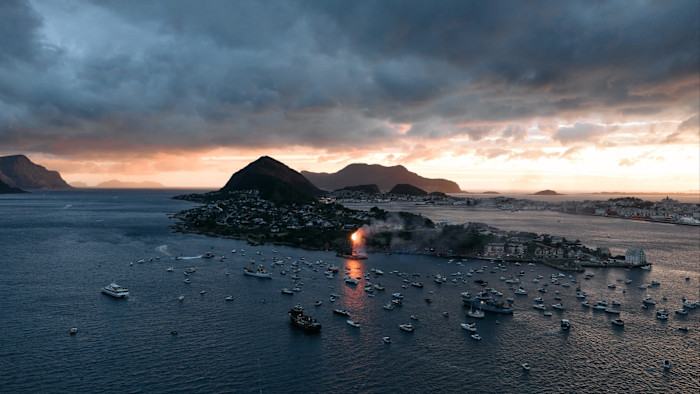
Ålesund, a city in the north-west of Norway, has a chequered history with fire. It was established in the 19th century as a market town and fishing hub. In 1904, however, a catastrophic fire ripped through the city and sent 10,000 people scattering into a cold January night to escape the flames. Some 850 buildings were destroyed — a terrible blow, but one that came at a strangely opportune time.
In 1905, Norway won its independence from Sweden, so when the time came to rebuild Ålesund, there was an appetite to make this new city representative of Norwegian identity as distinct from Sweden. As such, the whole city was recrafted with art nouveau buildings designed by leading lights in Norwegian and European architecture, inlaid with Viking motifs and painted in rich yellows, reds and greens. It became, and remains, one of the most picturesque places in the country.
Now, Ålesund is once again famous for fire, but in a different way. Every year since 1964, over two months in the early summer, locals build one of the largest bonfires in the world. Almost all the work is done, by hand, by teenage boys, who devote every night after school during the thick of exam season to constructing a tower made of leftover wooden pallets from local businesses. Scaling the tower with ropes and harnesses, the young builders painstakingly pass each one of the 15,000-odd pallets up in a relay, like ants conveying a leaf up a tree trunk. And then they burn it all down to celebrate midsummer, as thousands of people watch and party in the light of the blaze.
Two days before the burning (which takes place on the closest Saturday to the solstice, June 20 this year), I took a walk down to the shoreline at Slinningen, a village just outside Ålesund, where the bonfire is built. There is a stone platform, accessible by walking across rocks at lower tides, and here, towering over the sea and against the backdrop of distant snow-capped mountains, was the great pyramid of wooden pallets. With just 48 hours to go, the bonfire was already immense, roughly 27 metres and growing.
At a picnic bench above the beach, I met Éric Sagen Major, 17, and Philip Svorkmo Hessen, 18, this year’s bonfire chiefs. Each year, a couple of boys get tapped to be in charge of all aspects of the bonfire: the construction, sourcing the pallets, recruiting people to come and build. Philip has been taking part in the bonfire for four years, and Éric has been coming down here since he was 11.
Also with us was Alexander Heen, 30, who was a bonfire chief in 2016, the year Ålesund took home the Guinness World Record for tallest bonfire with a staggering 47-metre pyre. He speaks of it with a veteran’s thousand-yard stare. “It was terror,” he said. He had asked to take a year off his job in the military in order to gun for the record. “They were like, I think you need to do a psychiatric evaluation,” he said, laughing.


The taller a bonfire gets, the exponentially more difficult it is to construct. The pallets have their limits, pressure-wise. Beyond a certain height, the more you add, the greater the risk that the pallets on the bottom layer will buckle, and the whole thing will come crashing down. “We tested the physical limit of that in 2016, and my advice is, don’t do that,” he said.
The tradition of building one big bonfire has been passed from their fathers and grandfathers, they told me, but the history of bonfires in this region is much older. Back in the 18th century, every island settlement we could see from this picnic bench would have had its own small bonfire to celebrate the solstice, fireflies dotting around the archipelago.
To the boys who come to build (and it is usually boys, mostly because of the arduous physicality of the work, although girls are welcome), bonfire season is something like a summer camp and something like training for a sporting event. They watch what they eat, and how much sleep they get. For younger boys, who aren’t yet strong enough to flip pallets, they can get an apprenticeship in bonfire craft by doing odd jobs like sourcing the nails to secure the wood, and learn by watching their elders. Each time summer comes around, and you’re a year older, you can be given more responsibilities, and allowed to climb higher up the tower.


They do it, primarily, because it’s fun, and because it’s tradition. But it’s also come to be seen as a positive, character-building thing for boys to be doing — something that isn’t online. Both Philip and Éric have been inspired by their time at the bonfires to pursue futures in construction. “I love being tired and having done something,” said Philip.
As we had been speaking, more teenage boys had drifted over, pizza boxes in hand, ready to fuel up for another evening’s construction.
As I write this, we’re barrelling into our second consecutive week of suffocating high temperatures across western Europe. In Ålesund, in June, you’re lucky to see 20C, and soft rain blows in and out throughout the day. The summer holiday in Scandinavia has perhaps never been more appealing and Ålesund, and the surrounding Sunnmøre region, offer plenty to do for people looking for a cooler, outdoorsy type of break.
These days, Ålesund is a fully fledged holiday destination, though it still has the appearance of a quaint fishing port: statues artistically splattered with seagull poop and a postcard-ready lighthouse out on the harbour wall. It’s home to a couple of sleek, pleasingly Nordic hotels, including the Hotel Brosundet in the middle of town, where I stayed (or try the Storfjord Hotel, a 30-minute drive to the east), as well as a clutch of seafood-centric restaurants and museums of the city’s art nouveau and fishing history.


And then, of course, there are the fjords. You know about the Norwegian fjords, I know about the Norwegian fjords, but it’s difficult to really know about them until you see them with your own eyes. There is a viewpoint up above Geiranger, the town situated at the mouth of one of the area’s most dramatic fjords, where I found tourists just sort of shaking their heads in disbelief at the scene before them. It is preposterously impressive and beautiful, almost dangerously so, in that I kept feeling like I was going to crash my rental car on the drive over from Ålesund because I couldn’t keep my eyes on the road. One local told me that nature in Norway is loud (“it screams at you, almost”) and, at Geiranger, that noise is deafening.
In the town of Geiranger itself, there are perhaps a few too many coach drivers in plastic Viking helmets coming to pick up tour groups, but the smart money says go one fjord over to Øye if you want to feel more secluded. That said, the Hotel Union Geiranger is worth staying in for a night, for its extensive spa with a fountain of crushed ice you’re encouraged to rub all over yourself after getting out of the sauna, if you’re brave enough.


In Ålesund you are also only a couple of hours’ drive from an island called Runde, home to not much else besides a very large population of puffins. I spent a dramatically stormy night on the island in a cabin overlooking the sea, and joined a bird walk with the Runde Environmental Centre. Up on the cliff faces on the east side of the island, above lush grassland, the birds nest. I’m not a birder, but it is impossible not to warm to puffins who, with their anxious faces and clumsy gaits, often look more like they’re jumping from a burning building than taking flight.
“You can see Ålesund,” our guide Johannes Madsen said, pointing at a cluster of islands on the misty horizon. And when they burn the bonfire each year, it is visible all the way from here on Runde, some 30km away.
For people looking for a slightly cushier way to see the bonfire festivities, there are companies that offer boat trips out into the harbour with drinks and nibbles. Plenty of locals take their boats out for the bonfire, too, creating a flotilla that fills the bay. I wanted to get in amongst it a bit more, though, and watch from the shore at Slinningen. There are no tickets, and a handful of Portaloos and a Red Cross tent are all they put on in the way of infrastructure. Most of the thousands of people who come down here for bonfire night, camping chairs in hand and beers at the ready, live nearby. At the shoreline, people had set up barbecues, teenagers were loitering in that way that they do, and families were looking for sea creatures among the kelp while they waited for the fire to start.


I took up a spot on a tar-splattered jetty outside some boathouses, alongside a group of young people passing around a bottle. At 8.30pm, I heard distant chanting and saw the red glow of flares as the bonfire builders processed down the hill to the shoreline to cheering from their friends and families. There then followed a certain amount of friendly anarchy, as the boys gathered beneath the bonfire to play music, engage in a rowdy rendition of the song “Heads, Shoulders, Knees and Toes”, and set off fireworks, which seemed somewhat redundant given that, at this hour in the middle of summer in this part of the world, there is still full daylight.
As nine o’clock approached, five of the older boys began to scale the bonfire. At the very top were stacks of wooden barrels which contain a carefully calibrated mixture of petrol, which lights easily, and diesel, which stays lit for a long time. When the climbers reached the top of the tower, the sun broke the clouds and illuminated the entire tower for a few golden seconds as they took down the Norwegian flag. Cheers erupted from the shoreline as they lit flares and dropped them into the barrels.


Now, to an untrained eye, this looks like a mental thing to do. Surely it cannot be wise to set fire to something 35-odd metres tall while you are standing on top of it? But the barrels take a few minutes to catch fire, and the boys have time to get down to safety again. And then the party can begin. Shortly after the fire-starters hit terra firma again, they picked up one of their friends and unceremoniously chucked him into the sea, in jeans no less.
Down on the beach, at the boathouses and on the hillsides above the shore, there was a happy throng of local people catching up, and enjoying this annual opportunity to come together as a community. People told me that they come down here each year as a matter of Ålesund pride. But also, and naturally, they come simply because it’s an extraordinary spectacle. “It’s a fire! It’s big. It’s cool,” said one man called Simon who was cooking twist bread over a makeshift bonfire of his own when I asked him what brought him here.
By 10.30pm, however, things were not quite going to plan. There were flames at the top of the structure, but as yet no grand inferno. The bonfire burns just fine if it’s raining, I’m told, but wind is another matter, and it was a blustery night. I caught up with Alexander Heen down at the shoreline. The older bonfire boys had been celebrating their achievement with beers for an hour or so now, and would no longer be sober enough to go back up there with more flares if the fire needed a helping hand. This job would be falling to Heen. “Last year the whole thing was up and collapsing within two hours,” he said, “but I’m not too worried.”


The veteran’s assessment was correct. At last, at 11 o’clock, the tower suddenly caught. Flames ran down the structure and cast a red glow on the sea, and pallets began to topple off the top, smashing into cindered pieces and spreading the fire to the base of the tower. The late sunset cast the mountainsides in deep oranges as people moved their gatherings to places with the best view, to catch the moment the bonfire was finally fully lit. Half an hour later, the crowd at the shore turned as one to face the flames as the whole tower crashed down. Boats blasted their horns in celebration and drinks were raised in the air: a cheers to the start of a long, bright summer.
“I want to stay and watch it for hours,” I heard one man say to his wife, but she had other ideas. At midnight, the sky still light, it was all over for another year. I drifted back to town with the crowds, in search of the smaller fire in the grate of my hotel’s lobby to warm up.
Details
Imogen West-Knights was a guest of the tourist board Visit Northwest (visitnorthwest.no), and the airline Norwegian (norwegian.com) which has direct flights from London to Ålesund from about £110 return. The Hotel Brosundet (brosundet.no) has doubles from about NKr2,000 (£152); the Hotel Union Geiranger (uniongeiranger.com) has doubles from about NKr2,860. A five-hour puffin safari on Runde island, costs NKr995, including dinner; see opplevrunde.no
Find out about our latest stories first — follow FT Weekend on Instagram, Bluesky and X, and sign up to receive the FT Weekend newsletter every Saturday morning
Three more Norwegian coastal retreats

Ytri, Husøya Island The name comes from the Old Norse for “outer point” and Ytri really does offer the chance to get away from it all — even by Norwegian standards. Opened in May, the 38-room, five-star hotel is on Husøya, a far-flung island that is home to fewer than 400 people. Getting there by air involves flying to Bodø, then a ferry to the island of Onøy, followed by another boat to Husøya (in all, some five hours at sea). The reward is a dreamy hotel designed by Vardehaugen architects, who took inspiration from the area’s traditional fishing villages. It looks like a collection of wooden buildings, but with huge windows to take in views of the granite peaks and seascapes. Activities include exploring by bike, paddle-board or kayak (all free to borrow), snorkelling, scuba, fishing or freediving for scallops. Doubles from NKr5,100 (£387); ytri.no
Litløya Fyr, Vesterålen archipelago Further north, Litløya (literally “Little Island”) was once a busy fishing port but now its only permanent inhabitants are the owners of the lighthouse, which operates as a tiny boutique hotel. There are three doubles in the whitewashed former keeper’s house and one suite in the lighthouse tower itself. You can spot eagles and orcas from your room, or head out to explore on foot, in a kayak or on a boat trip. Access is surprisingly straightforward: drive to Bø on Langøya, then it’s 15 minutes by boat (included in the room rate). From NKr6,150 per person per night, including full-board and activities; littleislandlighthouse.com
Nusfjord, Lofoten Nusfjord is the archetypal Norwegian fishing village, a scattering of red and yellow-painted wooden cabins propped on wooden stilts above the rocky shore of the Lofoten archipelago. Today it is a sort of Arctic albergo diffuso with 25 historic cabins available to guests. Surrounded by jaw-dropping scenery, it is also becoming an unlikely artistic hub: a former salting facility has been converted into a contemporary gallery which until the end of October is acting as a northern outpost for Stockholm’s Fotografiska gallery, ahead of its opening in Oslo in 2028. Cabins for two from about NKr2,100; nusfjord.com

