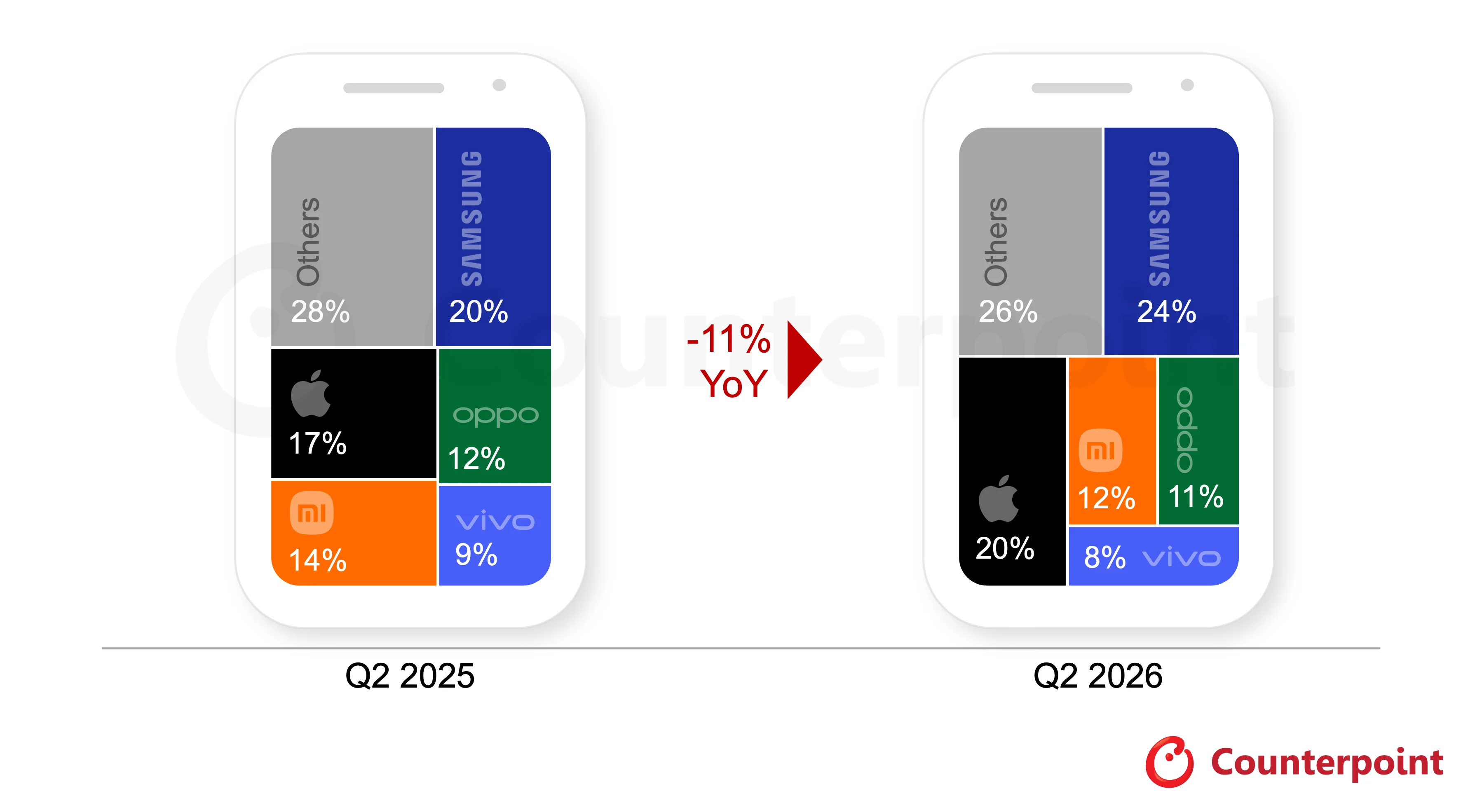

Samsung’s shipments were up as well, once again making it the largest global smartphone OEM by shipments, at 24 percent. Samsung’s focus on flagship phones has apparently helped it even as it raised prices on budget devices. The Galaxy S26 series, and particularly the Ultra variant, have sold better than last year’s models in spite of higher prices. Samsung is also strong in markets like India and the Middle East where lower prices and aggressive promotions have buoyed sales.
For what it’s worth, Omdia is reporting a smaller 4 percent drop for Q2 smartphone shipments, but it, too, shows Samsung and Apple sustaining sales as other OEMs fall. In its report, Omdia puts Samsung at 22 percent of all smartphone shipments, with Apple just behind at 20 percent.
Like other OEMs, Samsung has boosted prices on its mid-range and budget offerings, which has depressed sales. Budget-conscious buyers are just holding onto their current devices longer, taking advantage of a recent shift toward longer update support. Samsung and Google, for example, now support phones for seven years. That’s on par with Apple’s support window.
Speaking of Google, the company’s Pixel phones don’t get it anywhere close to the top five list, but its shipments are still growing at an impressive rate. Counterpoint says Google saw a 16 percent year-over-year increase in Q2 thanks to strong Pixel 10 sales.
Increasingly, it looks like AI hysteria is going to be a watershed moment for smartphone makers. Every analysis (including Counterpoint’s) expects the component shortage to continue at least into next year. Even if AI is a bubble, smartphone makers will probably spend the next year eliminating budget phones with low margins and increasing prices on the models that remain. This will encourage people to treat smartphones more like appliances, purchased less often and with the expectation of lengthy support.