
One might have a certain expectation about visiting an erotic novelist at home. I’ve learnt that it is often wholly misplaced (Jilly Cooper’s house in the Cotswolds was as spicy as a vicarage). And yet, as I walk through a Biennale-thronged Venice, with the sky quivering between bright sunshine and black thunderstorms, on my way to meet Lisa Hilton — the English historian, presenter and author of several lusty thrillers — I can’t help wondering what’s on the cards.
Hilton scoops me up at her local vaporetto stop (Venice’s boat equivalent to a bus stop) to escort me to her garden flat off a nearby courtyard. It’s a cinematic pocket of the city, cloistered near the Peggy Guggenheim Collection in the far reaches of Dorsoduro, Venice’s university district. Hilton has the ground floor of a 16th-century sugar merchant’s house. Calle dello Zucchero — Sugar Street — is some 50 metres away, near the old customs houses.
Inside, it is cosily crepuscular, countering the vast canopy of light beyond the walls. There are no Eyes Wide Shut masks though, just Moth — Hilton’s ankle-friendly long-haired half-Maine Coon cat — and a tray laid out with a silver pot of coffee and homemade peach-and-ginger cake.
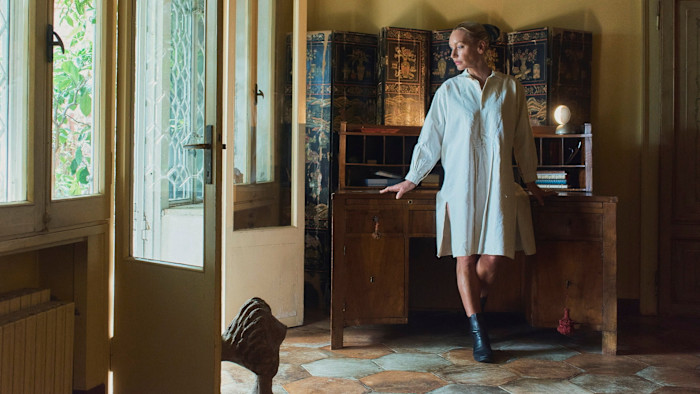
“It’s not a very grand flat,” says Hilton, setting out the cups and plates. Even so, it has an atmosphere. Hilton has created a spare and enigmatic aesthetic — a few pictures, a few objects — which matches her quietly elegant appearance: Katharine Hepburn-esque trousers, white shirt, long tousled hair.
When I ask about the unseemly assumptions of visitors, Hilton laughs and says that people are more likely to wonder about finding “a body in the wardrobe” than a sex toy on the sofa. Perhaps understandably: her 2016-18 Maestra trilogy of erotic thrillers, set in the art world, delivered a high body count, both between the sheets and in the morgue.
Her latest novel The Model pulls on a similar thread, this time located in the modelling scene of the 1990s. “When I was younger I had a very brief, extremely unsuccessful career as a model,” she says. “I only got rubbish jobs like Clairol hair dye.”

Crowds of fashionistas and art-world players have just arrived in Venice for the Biennale, which adds further numbers to what is already one of the world’s busiest tourist destinations. Not that you would know it in Hilton’s apartment. She guides me outside to her garden; I can’t even hear the gulls. It’s an enviably silent and cool bolt-hole in a sometimes loud and hot city. I’m given mosquito spray — “Venetian mosquitoes are fiends” — and two wedges of cake.
The wall on the west side of the garden has recently had a glorious curtain of jasmine stripped away for renovation, notes Hilton. “Obviously the wall fell down immediately.” It’s a reminder that La Serenissima, as the city is known, is an eternal work in progress, alive with the sound of workmen. The garden’s key feature is a Byzantine well sitting in a sunken terrace, carved with Syriac peacocks and lions. Palm fronds splay above. The wells of Venice are fed by a system of rainwater piped to cisterns. You can drink it, Hilton says. “I’d probably boil it first.”


Hilton grew up in Frodsham, a small market town between Liverpool and Manchester, and read English at New College, Oxford. After studying art history in France and Italy, she began writing. “Loads of serious history books that no one takes any notice of,” she says. Her non-fiction subjects have ranged from the Restoration-era playwright Aphra Behn to Queen Elizabeth I.
She also spent a short period working at Christie’s auction house, experience she later corralled into the plotline of Maestra (a junior specialist assesses men’s proclivities as well as the provenance of pictures). “My then-agent’s husband said, ‘I bet you can’t write something sexier than [Fifty Shades of Grey author] EL James.’”

She soon found her erotic alter ego: LS Hilton. “Those books were such a disaster for me really. They were meant as satire, something jolly and fun to read,” she says — but they left her pigeonholed as a frothy author rather than a “serious” historian. Marketing shots for Maestra featured her lying on a desk with stiletto heels pointing to the ceiling. Her subsequent novel All My Lovers’ Wives ripped into the publishing industry. Universal Pictures has bought the film rights, she says, but “no English publisher will touch it”. French publisher Massot Éditions stepped up to the plate.
Hilton’s introduction to Venice was pure Hollywood. At 19, she visited the city with a university boyfriend whose father is Roland Joffé, director of 1980s Academy Award-winning films The Mission and The Killing Fields. “He used to take a suite at the Gritti for New Year,” she recalls.
“We arrived very late at night. It was the caìgo, the very heavy mist. And the next morning, Roland put a blindfold on me and walked me to San Marco because he knew I’d never seen Venice. I took the blindfold off. I didn’t know that such loveliness could exist. It was about 7am, one of those bright blue and gold winter days. And I thought: one day I will live here. I’m a person with very greedy eyes.”

Having previously lived in France and the US, she moved to Venice from London in 2018, partly as a reaction to Brexit but also to give her daughter the opportunity to go to school in Italy. Divorced three times, “I was sort of done with London and London was done with me,” she says.
She initially rented the ramshackle back half of the apartment: “It was like a granny’s house. The garden was so overgrown you couldn’t open any of the windows.” She subsequently convinced the landlord to lease her the whole floor. Now there are three small bedrooms, a study, a bathroom and kitchen (both cabin-sized), and a living room, where she writes at an antique desk.

The year after she arrived, reality set in. The exceptional floods of 2019 (the infamous “Acqua Alta”) saw her lovely new home “knee deep” in water — “it came up through the floor,” she says — as “6ft-high waves” hit the city’s wharves. She and her daughter were trapped in the house. “It was a trauma.”
Watermarks are still visible on the walls, sharing space with personal objects and artworks: a collection of Murano glass ashtrays, a landscape by the postwar Italian photographer Mario Giacomelli, a cinema timetable salvaged from a dustbin in Tangier. At the end of her bed, a 19th-century late-Ottoman wall hanging of red fruits and foliage brings a splash of colour.


Floods aside, Hilton insists that the city’s charm wins out. “One has to resign oneself to a much slower pace of life. At first, it was like going back to 1950. There was no Amazon, you couldn’t pay with contactless. It’s still the case that if you forget to buy the milk on a Saturday, you’re stuffed until Tuesday. Going to get the dry cleaning? Maybe it’s going to be open, maybe it’s not.”
She has adapted to the tempo: in winter there are dinner parties and friends project films on their walls; in the summer she putters around in her tiny 9.9-horsepower boat. “My boat is even more staid than me.”

In literature, Venice is often depicted as a place of deadly encounters and melancholy introspection. Even her well has sinister connotations. “In the 18th century, the Venetian police had this unsolved case. Bits of people had been turning up in wells all over this district,” Hilton tells me. The murderer was a woman. “She hadn’t done the chopping up part; she had an accomplice for that.”
But, she says, Venice is really a lively “cosmopolitan village” with a thriving cultural life all year round. “What other city has 15 world-class museums? Where else can you say to your friend, ‘Oh, I’ll pop round in 20 minutes’? It’s very easy to meet people. Everyone knows everyone.” Is that a good thing? “Well, it’s no good if you’re planning on committing adultery. You have to go to the mainland for that.”
‘The Model’ by LS Hilton is available at audible.co.uk
Find out about our latest stories first — follow @ft_houseandhome on Instagram
