
This article is an on-site version of our Europe Express newsletter. Premium subscribers can sign up here to get the newsletter delivered every weekday and fortnightly on Saturday morning. Standard subscribers can upgrade to Premium here, or explore all FT newsletters
Good morning. Today, our Turkey correspondent reports on the arrest of one of the country’s top comedians as part of a sweeping crackdown on civil society by the ruling regime ahead of this week’s Nato summit in Ankara. And Ireland’s health minister tells our correspondent how faster drug approvals will be a priority for Dublin’s six months in charge of the Council of the EU.
Erdoğan’s punchline
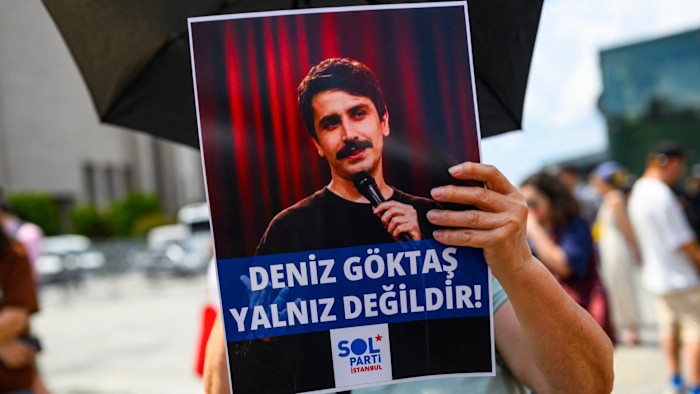
Talk about gallows humour. When Turkish comedian Deniz Göktaş recorded his latest stand-up routine in which he described President Recep Tayyip Erdoğan as “a dictator”, he performed in front of a giant cardboard sculpture of his own head lying on its side, apparently decapitated, writes John Paul Rathbone.
Context: Göktaş’s arrest on the eve of this week’s Nato summit in Ankara is one incident in an ongoing security crackdown by Turkish authorities that critics say is part of a broader stifling of dissent by Erdoğan’s government.
As foretold by his stage prop, the 32-year-old comedian was arrested soon after on charges of “inciting hatred and hostility” and insulting the president, a Turkish criminal offence punishable by up to four years in prison.
The incident is a reminder of what Turkish opposition leader Özgür Özel, writing in the FT last week, described as Erdoğan’s “assault on democracy” and the risks to Turkey’s Nato allies “that Erdoğan’s rule poses to their own interests”.
Nato leaders, including US President Donald Trump, are likely to sweep any concerns about Turkey’s democratic backsliding under the red carpet of Erdoğan’s Beştepe presidential complex, where the summit will be hosted on July 7 and 8.
Turkey’s military strength, burgeoning defence industry and heightened geostrategic importance after Russia’s invasion of Ukraine and the Iran conflict all but ensure that.
But such matters of state have not stopped more than 11mn Turks from watching Göktaş’s show since it was posted on YouTube 10 days ago, tuning in as the psychology graduate pokes fun at religion and politics, fatherhood and journalism, the president and his biggest opposition rival, jailed Istanbul mayor Ekrem İmamoğlu.
The comedian’s wit and spirited catchphrase “they cannot steal our joy” has captured the public imagination and turned the 32-year-old into something of a folk hero. Journalist Fatih Altaylı, who Göktaş satirised in the show, said “watching it made me feel like we are living in a normal country.”
Göktaş’s arrest has also prompted unfavourable comparisons with former prime minister Süleyman Demirel, who reportedly ordered the release of a man detained for insulting him during a 1979 by-election campaign, saying: “I’m not complaining . . . release the man immediately!”
Chart du jour: Where it hurts
Ukraine’s intensified drone campaign is hitting Russian refineries at record levels, fuelling severe petrol shortages and putting Moscow’s air defences — and economy — under growing strain.
Drug deals
Getting new medicines to patients more quickly and at lower prices will be a priority for Ireland’s EU presidency, the country’s health minister tells Andy Bounds.
Context: Patients wait a median of 532 days to access a newly approved drug, ranging from 56 days in Germany to 1,201 days in Romania, according to pharmaceutical lobby group Efpia.
Jennifer Carroll MacNeill told reporters during a visit to Cork, a pharmaceutical hub, for the start of the six-month presidency that cutting those delays was a priority.
She said a planned biotech act should also incentivise research in the EU at a time when it is losing investment to the US and China.
“It’s a really important moment for the European Union to look at how it is regulating medicines,” she said. “I’m quite conscious that a drug . . . goes through a very different domestic process and some of those are efficient and some others are not efficient.”
Health is a national competence, with national systems deciding whether to allow a new drug and how much they are willing to pay for it once the European Medicines Agency approves it.
Health ministers would discuss how to streamline those processes, she said.
In 2025, almost half of new medicines were not available to patients in Europe, up from 46 per cent in 2019. Only 28 per cent were fully reimbursed by public money, down from 42 per cent in 2019.
MacNeill said countries should collaborate to drive down prices.
“Some of the member states are in quiet competition with each other without having the best of information, so we don’t know how each other is negotiating with the same company and that’s something of a strategic disadvantage.”
What to watch today
-
European parliament plenary session begins in Strasbourg.
-
Nato secretary-general Mark Rutte gives a press conference ahead of the alliance’s summit this week.
-
Informal meeting of EU employment and social affairs ministers in Mayo, Ireland.
Now read these
Are you enjoying Europe Express? Sign up here to have it delivered straight to your inbox every workday at 7am CET and on Saturdays at noon CET. Do tell us what you think, we love to hear from you: [email protected]. Keep up with the latest European stories @FT Europe
