


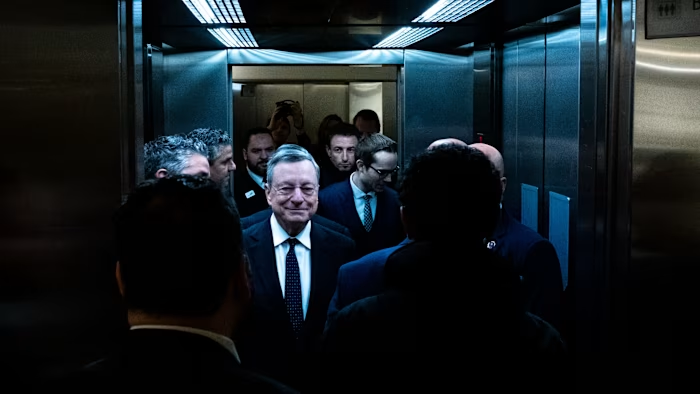
Two years after Mario Draghi warned that the EU faced “slow agony” unless it tackled its competitiveness crisis, little of his prescription has become reality.
Only 15.7 per cent of the 383 recommendations in Draghi’s report had been fully implemented by July, according to a tracker compiled by the European Policy Innovation Council, a think-tank. The limited progress comes despite repeated pledges by EU leaders and European Commission president Ursula von der Leyen to put economic revival at the centre of the bloc’s agenda.
“We are doing better, but we are not doing good enough,” said Martin Lidegaard, Danish minister for business and competitiveness.
Endorsed by von der Leyen as the policy blueprint for her second term, Draghi’s proposals have been crowded out by the war in Ukraine, migration and the battle over the EU’s next shared budget.
The most consequential reforms — integrating capital markets, removing barriers inside the single market and cutting strategic dependencies — remain trapped in the national politics his report was meant to overcome.
Other measures, from integrating fragmented energy markets to harmonising rules on defence procurement and telecoms, have advanced only fitfully.
The delay comes as the US and China extend their lead in the global race on AI. US growth has been lifted by investment in AI, data centres and advanced semiconductors, with the country consistently outpacing the EU in GDP growth since July 2024.
The “Draghi watch” tracker found that 41.3 per cent of the former Italian prime minister’s proposals had been partially implemented, underscoring the distance between Brussels’ declared ambitions and member states’ willingness to surrender control.
A separate study by Institut Montaigne, using a different methodology, paints a more optimistic picture, concluding that about 30 per cent of Draghi’s recommendations have now been implemented.
But both trackers point to the same problem: the most politically difficult reforms still lie ahead. Many would touch on powers held by national governments, making them harder to agree.
To overcome inter-institutional squabbles, the Commission, European parliament and member states agreed earlier this year on specific deadlines to implement the competitiveness agenda.
Enrico Letta, another former Italian premier who wrote a separate report on integrating the single market, recently said he was “more optimistic” about Europe getting its act together because now there were clear plans and deadlines in place.
But progress so far has largely come where the Commission could act on its own: cutting regulatory burdens, improving access to finance for companies seeking to scale up and accelerating permits for clean technologies.
The gap between ambition and implementation has barely narrowed.
The EU’s recently agreed digital declaration system for posted workers was meant to create a single online form for companies across the bloc. Instead, negotiations were slowed by member states, including Germany, adding national reporting requirements to what was supposed to be a voluntary system.
The initiative was agreed before an EU leaders’ deadline, allowing Brussels to mark progress on competitiveness. But officials privately question whether it will make much difference for businesses.
“This is now a box that we can tick off in the competitiveness scoreboard. But whether it will actually make much of a difference is yet to be seen,” said one EU official.
While leaders, including German Chancellor Friedrich Merz, routinely call for a more integrated single market and less bureaucracy, their national ministries often remain reluctant to surrender powers or abandon domestic rules.


Mario Monti, the former Italian prime minister whose own report on the single market was published in 2010, said Draghi’s proposals risked meeting the same fate.
“The only report that should be produced in the future is a report on why normally the recommendations of the reports are not followed,” Monti recently said.
Such reports are usually greeted by “a round of applause, which lasts about one day”, he added, before governments, business leaders and national administrations “begin the following morning to do whatever it takes to unravel the proposals”.
Many of Draghi’s most consequential recommendations require governments to surrender powers or accept deeper economic integration — steps that remain politically sensitive.
“The implementation bottleneck comes from national resistance . . . and a lack of political courage to face necessary trade-offs,” said Oscar Guinea, of the European Centre for International Political Economy, adding that “some critical policies are paralysed at the member-state level”.
Lidegaard, the Danish competitiveness minister, said “there is relatively high agreement on where we need to go, but how to get there, you still have robust discussions”. Those divisions are clearest over plans for a unified EU capital market, widely seen as a missing piece in Europe’s competitiveness puzzle. Fragmented markets continue to deprive companies of the financing needed to scale.
Ireland, which takes over the EU’s rotating presidency in July, has promised to reach a political deal by the end of the year.
When it comes to the bloc’s competitiveness agenda, Ireland was going “to go at these as energetically and aggressively as we can”, Irish Prime Minister Micheál Martin told the FT.
“Europe has to make a leap forward because competitiveness is a key issue vis-à-vis the US, vis-à-vis China,” he said.
Business groups broadly welcome what they describe as a philosophical shift compared with von der Leyen’s first five years at the helm of the Commission.
“Now it’s clearly understood that all the changes we need, from defending the planet down to defending the social peace in Europe, you need growth, ie fiscal revenues to finance them,” said Maciej Witucki, president of BusinessEurope, the continent’s biggest business lobby.
But he warned that translating that philosophy into action was proceeding too slowly, a warning echoed by others.
Per Franzén, who leads EQT, the largest venture capital investor in Europe, said he was “encouraged by what I’m hearing from politicians and decision makers, but it needs to move quickly”.
