


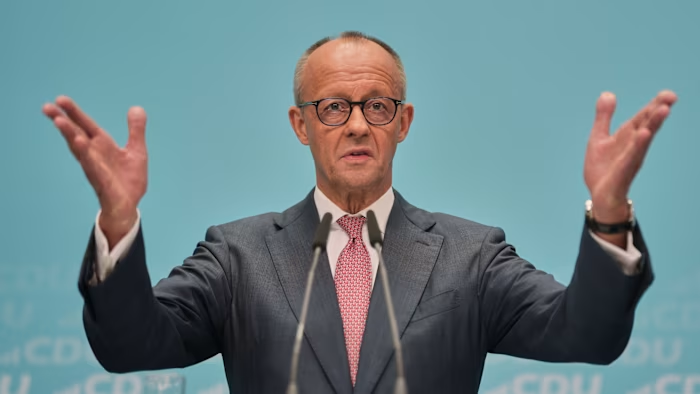
Chancellor Friedrich Merz has hit out at “destructive” populist parties gaining ground in Germany as he battles for his political future following a string of electoral victories for the far right.
In a news conference on Monday, Merz acknowledged that widespread discontent with his government as well as his own personal unpopularity had played a role in what he called a “dramatic result” for his Christian Democratic Union in Sunday’s regional election.
For the first time in any regional vote in Germany’s postwar history, the CDU missed the 5 per cent threshold to enter parliament in Mecklenburg-Vorpommern. The far-right Alternative for Germany (AfD) came first with 38 per cent, its best result in that state. The party’s victory comes just two weeks after it secured a similar result in Saxony-Anhalt, another eastern German state where it is now seeking to form a government.
Still, Merz said that even if he took responsibility for the results, the causes went “far beyond me personally”. After meeting twice with senior party members, he insisted that “no one” had raised questions about his personal capacity as party leader and chancellor.
Elections also took place in Berlin, where the CDU fared better but saw its vote share fall by almost 10 points to 18.8 per cent as it haemorrhaged support to the AfD.
The CDU, which has governed the German capital for the past three years, was pushed into second place by a surge in support for the anti-capitalist Die Linke. The hard-left party has pledged to expropriate property from corporate landlords and has also faced accusations of antisemitism.
Merz said the EU’s most populous country was undergoing a “profound transformation of the political party system” that he said was also taking place in many other countries around the world.
Pointing to the result in Berlin, he said that more than 40 per cent of voters in the German capital had backed forces that were “destructive, question our political parliamentary system and try to lure people with radical and simple solutions”.
He added: “The extremists suggest that there are simple solutions. But anyone who has ever governed knows there are no simple solutions.”
The German leader said that his CDU was now facing “fundamental and very long-term questions” and vowed it would seek to draw the lessons from the defeats.
“We will talk about the work and structure of the party, about our programme and about the profile of the CDU,” he said. “To put it bluntly, we no longer have satisfactory answers to far too many questions. We will, and we must, change that.”
Merz said that many people were worried about their jobs, their families and their healthcare. He said it was the “historic responsibility” of his coalition with the Social Democrats and of other centrist parties to tackle these issues.
Mecklenburg-Vorpommern is Germany’s third-smallest state with just 1.5mn inhabitants. It has specific grievances linked to its past as part of East Germany and reunification. But the failure to cross the threshold has aggravated Merz’s political woes — with his popularity at record lows after just 16 months in office.
The pain was compounded by the fact that the region is the home state of his longtime rival Angela Merkel, the former CDU chancellor, who held a seat in Mecklenburg-Vorpommern for 31 years.
In both Berlin and Mecklenburg-Vorpommern, the hard left and the far right managed to mobilise large numbers of people who had previously not voted.
Nico Lange, a former CDU adviser and director of the Berlin-based think-tank IRIS, said the results showed “clear shifts towards the political fringes” taking place in a country once dominated by the centre-right CDU and centre-left SPD, known collectively as the Volksparteien — people’s parties.
Alice Weidel, co-leader of the AfD, said the party’s back-to-back wins in Saxony-Anhalt and Mecklenburg-Vorpommern “clearly demonstrate that we have displaced the CDU as a Volkspartei.”
She said Merz’s vow to fight on as chancellor and party leader was “very strange”, adding: “We do not believe the CDU can carry on like this. We shall see what the coming weeks bring.”
Merz said the results underlined the need to press on with painful reforms, including raising the retirement age from 64 to 67.
But with deep discontent in his party — as well as turmoil within his coalition partners from the SPD — it remains unclear whether he has the political capital to see them through.

On Monday, Manuela Schwesig, the SPD prime minister of Mecklenburg-Vorpommern, who is likely to stay on at the helm of a coalition government, criticised the chancellor for “misjudging the situation”. Schwesig campaigned against raising the retirement age and her stance is an early sign of tension within the SPD over this and other Merz reforms.
Merz’s CDU on Monday held a series of crisis meetings, convening the party executive committee and its board.
The CDU’s state premiers, who last week rallied behind Merz in a joint statement, met in Berlin on Sunday night but did not issue a public statement. Merz has convened another meeting with them later this week.
Despite deep discontent with Merz, there appears to be no clear successor ready to replace him. Hendrik Wüst, the premier of North Rhine-Westphalia, is widely viewed as the most likely alternative as CDU leader and chancellor. But he faces elections in his own state in April.
Markus Söder, the state premier in Bavaria, is seen as another potential contender. On Monday he called on the CDU and its Bavarian sister party, the CSU, to end the leadership debate. “We stand united and want to discuss issues of substance and structure now, not personnel matters,” he said.
Data visualisation by Martin Stabe
