


Unlock the Editor’s Digest for free
Roula Khalaf, Editor of the FT, selects her favourite stories in this weekly newsletter.
The decision to stage Olivier Messiaen’s vast Saint François d’Assise is as much a spiritual commitment as it is a logistical challenge. This year’s new production for the Salzburg Festival runs to a gruelling six and a quarter hours (including intervals), which, however much you love the music of Messiaen, is a long sit. Add a huge orchestra, a battery of percussion, an enormous chorus, demanding solo roles, and the fact that the story contains little action, and you end up with something that reads more like an act of devotion than a work of music theatre.
That was certainly the case for Messiaen, who adored both Saint Francis and his birds. And it became the case for cultural icon Gerard Mortier, who on his appointment as artistic director in 1991 dragged the Salzburg Festival, kicking and screaming, towards the 21st century. It was Mortier who made Salzburg the artistic trendsetter of Europe, and Mortier who hauled Messiaen’s colossus with him around the Continent, from Salzburg to the Ruhrtrienniale, then on to Paris and Madrid. I recall Mortier’s obsession with Saint François sparking speculation that he had promised God performances in return for his hedonistic habits; whatever the truth, his Jesuit education was never far from his mind.
Poor Salzburg. Mortier’s programming was the fruit of the knowledge of good and evil; every director since his 1991-2001 leadership has lived in his shadow, trying either to invoke or repudiate his combative stance. And now, with a bitterness worthy of Salzburg author Thomas Bernhard at his bleakest, intendant Markus Hinterhäuser has been forced to throw in the towel after years of his own struggles. He could not have known that this François would be his swan song, but nothing could be more fitting; a nod to the intellectual convictions of his erstwhile mentor, a homage to Hinterhäuser’s favourite era of faded modernism, and also, alas, an enforced act of penance for the audience.
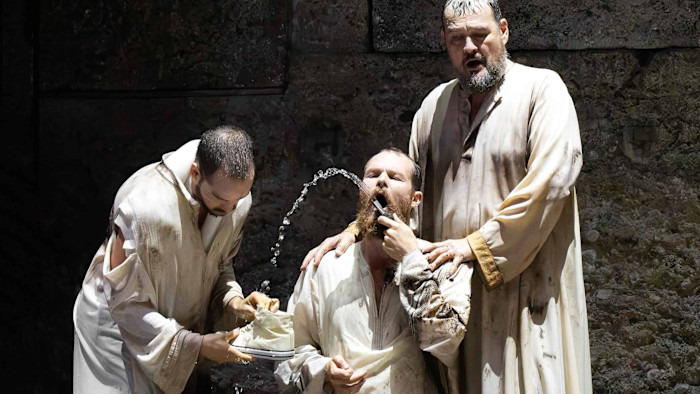
Director Romeo Castellucci takes the subject matter seriously. An inveterate symbolist, he could have worked well with the opera’s trance-like stillness. Instead, his staging reads as if he underestimated the work’s magnitude, and then panicked. In a promising opening, where the opera appears to be transposed into a modern-day setting, François leaves his parents in a monastic art gallery to take orders, and begins to slide into an increasing state of psychosis. He smears himself in grime, self-mutilates, eats magic mushrooms and thrashes about hysterically. All this while singing magnificently — Philippe Sly is remarkable in the title role. All the singers are impressive.
But it is hard to be drawn into Messiaen’s music when conductor Maxime Pascal so demonstrably is not. Of course, a piece of this scale requires a conductor who functions as a kind of air traffic controller, but Pascal never seems to concede that there is actual music between the arrivals and departures. Messiaen’s complex score is littered with meticulous dynamic instructions. Pascal appears to ignore them, forcing out shapeless melodic lines as though Messiaen had written for robots. What a waste of the Vienna Philharmonic! The musicians play as if this were an unpleasant household chore. And so listening becomes equal drudgery.
There are moments of magic, and others of shock — like the little bodies of dead and dying birds that thud onto the stage. Some are still fluttering. He wouldn’t — would he? Castellucci knows his own reputation for blending harsh reality with performance well enough to play with our sense of outrage.
The flock of sheep trotting across the stage during the final bars is very real. Are they a biblical reference? A glimpse of nature? Tomorrow’s sweaters? Or just a bunch of woolly opera-goers? Saint Francis urged his friars to be like sheep among wolves and an actual wolf crossed the stage in the previous act. Fortunately, it seems that there are limits to Castellucci’s literalism — the animals were not brought together for the curtain calls.
★★★☆☆
To August 23, salzburgerfestspiele.at
