


Unlock the Editor’s Digest for free
Roula Khalaf, Editor of the FT, selects her favourite stories in this weekly newsletter.
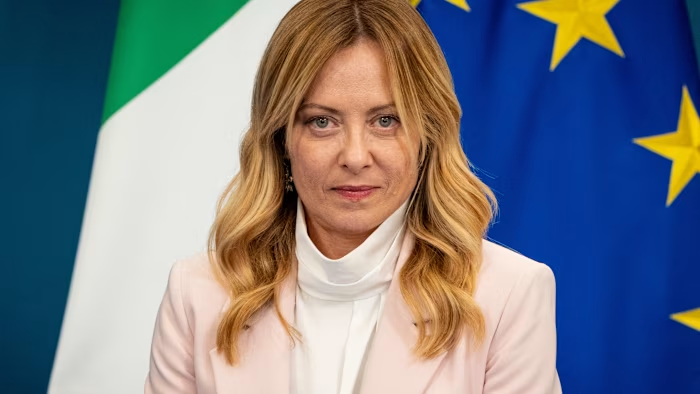
Giorgia Meloni on Friday notches up 1,413 days in charge of her rightwing coalition government. Hers becomes the longest continuous Italian administration since the second world war, surpassing the longest of Silvio Berlusconi’s three stints in office. It is a considerable achievement given the government instability that has plagued postwar Italy. It also stands out in today’s Europe, where stability and long-termism have become sadly underrated.
Britain has just acquired its fifth prime minister in four years. France is on its fourth since President Emmanuel Macron’s gamble to dissolve parliament in 2024 left it paralysed. Even Germany is going through a period of turbulence, with Chancellor Friedrich Merz wobbling after barely 16 months in power.
A populist firebrand in opposition, Meloni has governed more astutely and pragmatically than Italians or Europeans could have hoped from the leader of a party with neo-fascist roots. She stamped her authority on a coalition comprising her rightwing Brothers of Italy, the late Berlusconi’s centre-right Forza Italia and the anti-immigration League. She is tough, hard-working, holds her own with other world leaders and has a gift for political communication. She is unquestionably the dominant force in Italian politics.
Meloni has brought stability to Italy, governing not as the radical some feared but as a conservative. It is why she is reviled as a sellout by far-right hardliners in Germany, France and now in Italy too. To be sure, she has taken a strict line on irregular migration, setting up an offshore processing centre in Albania for asylum seekers. She has rounded on the judges who blocked the centre’s operation and other parts of her agenda. She has clamped down on parental recognition for same-sex couples and banned surrogacy abroad. She also wants to tinker with the electoral system in ways that could boost her coalition in the next election, due by the end of 2027.
But Meloni has stuck to constitutional convention and to the foreign policy orientation of her mainstream predecessors. She has maintained fiscal discipline and cut the deficit, keeping bond yields relatively in check and investors happy. She has proved a co-operative player in the EU, working with other leaders, especially Merz, to pull it to the right on immigration, the energy transition and regulation. She remains a staunch supporter of Ukraine, in a country with widespread pro-Russian sympathies, although, like others, she could do more to help Kyiv. Having aspired to act as a Maga-compatible bridge between Europe and the Trump administration, she has ended up clashing with the US president like everyone else.
Meloni’s political capital remains intact because she hasn’t tried to use it on painful economic, welfare and public administration reforms. Rome has worked with Brussels to spend a €200bn EU pandemic recovery fund, but has failed to use it as a unique opportunity for economic transformation, repeatedly rejigging programmes and postponing reforms. It is hard to identify a standout reforming achievement of her tenure, which may be why she and her allies make so much of her endurance in office.
Most importantly, given Italy’s public debt mountain and the pressure on its industrial export model, Meloni has done almost nothing to raise her country’s growth potential. GDP growth has been feeble and living standards stagnant. This helps to explain why she now risks being outflanked on the far right by Roberto Vannacci, a pro-Moscow anti-immigration hardliner who claims that restarting cheap energy imports from Russia is the answer to Italian woes.
Meloni has brought enviable stability to Italy but has not used it to transform her country’s prospects. Nearly four years in office is an achievement, yes, but also a missed opportunity.
