


At Godfried Donkor’s studio in south London, a canvas leans against the wall, ready to transport to the Arsenale, where the main exhibition at the Venice Biennale will unfold. At its centre, Caribbean-born boxer Peter Jackson is depicted with angel wings; below him, a dragon and a ship; above, the words “Kumasi” and “Gold”. The backdrop resembles a close-up of the Financial Times’ pink pages, on which numbers sit alongside names: Muhammad Ali, Michael Jackson, Louis Armstrong. Based on the iconography of St Michael vanquishing a dragon, the work stitches together the artist’s many interests, from the history of the slave trade and the African diaspora to superheroes and sport.
At first Donkor considered experimenting with sculpture. “I thought, ‘what’s the biggest, grandest thing I could do?’ I wanted to make her proud,” he says, referring to Koyo Kouoh, who was appointed in 2024 to curate this year’s Venice Biennale but died of cancer last May, aged 57. In the end, he revisited her biennale title, In Minor Keys, reading it as a prompt to resist spectacle and return to the essence of his artmaking. “Minor keys do not scream or force themselves on to you,” he says. “They just carry the tune.”
It is an unusual year for the biennale. A Cameroonian-Swiss curator known for her pan-African scope, Kouoh had developed a theoretical framework for the exhibition, and had selected artists, but it has been left to her curatorial team to complete the project. Politically, it has also been a tumultuous period, which puts pressure on Kouoh’s intention that the exhibition be “neither a litany of commentary on world events nor an inattention or escape from compounding and continuous intersecting crises”.
Instead, In Minor Keys turns to art grounded in emotion and sensation and forms of knowledge marginalised by colonial expansion and capitalist extraction. In these registers, Kouoh suggests, lie beauty, joy and solace, as well as an enduring radicalism. “This exhibition is going to remind us how much of our humanity is still there to be explored,” says Maria Magdalena Campos-Pons. A key figure in the post-revolutionary Cuban art movement, Campos-Pons uses painting, sound, photography, performance and sculpture to tell stories informed by her ancestral African, Chinese and Hispanic heritage, and will exhibit in Venice with her long-time collaborator, the musician Kamaal Malak.

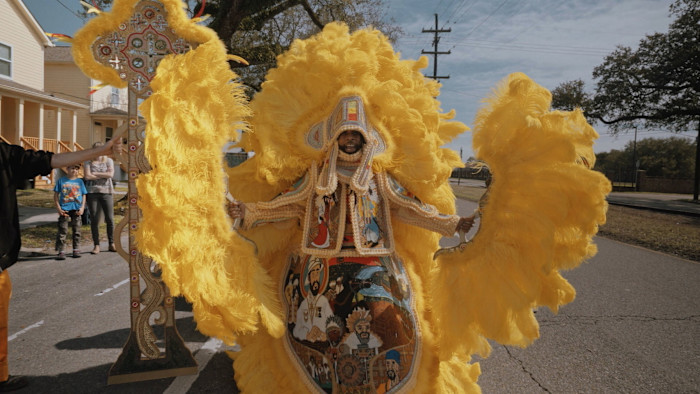
The theme is broad enough to elicit a wide range of responses among the 110 participants, from Mohammed Joha’s outdoor installation that spotlights the devastation and resilience of Gaza and Carsten Höller’s colossal sculpture that literally aims to make the viewer feel “minor”, to Demond Melancon’s beaded works derived from New Orleans’ Mardi Gras traditions and Tammy Nguyen’s Dante-inspired paintings which trace the cold war’s ripple effects.
Yet across this diversity, artists speak of nuance, slowness and attention — of rejecting dominant narratives in favour of the lesser heard. Walid Raad, whose films and photography deal with the contemporary history of Lebanon, contrasts Kouoh’s focus with the “major keys of security, energy, and finance”.

“It is less about declaring meaning and more about creating conditions for perception to shift,” says American artist Kennedy Yanko, who creates laboriously crafted abstract sculptures using found metal and paint skins.
It’s a departure from what we’ve come to expect in recent decades. In the face of injustice and political upheaval, contemporary art has tended to respond with equal force: through confrontation, critique, cynicism and conceptual abstraction. Kouoh’s proposition compels us to reckon with what art’s purpose even is. “It’s never been more clear to me that art is a pretty modest endeavour: our aims as artists might be radical, but our work is only a suggestion,” says Johannesburg-based artist Nolan Oswald Dennis. “Koyo’s invitation has forced me to rethink the importance of small creative acts.”
Sohrab Hura, whose work has moved in recent years from documentary photography to more intimate, ambiguous drawings depicting everyday life, echoes this. “I don’t want to consider myself an activist,” he says. “When I started out, my work came from a place of hope, in terms of using it to make a difference. Now, I feel my role is to deal with doubt and confusion in a soft way.”

The exhibition’s emphasis on ambiguity risks being read as a refusal to engage with the urgencies of the present. Beyond the main exhibition, the Biennale is already entangled in international politics, from the reopening of the Russian and Israeli pavilions to the banning by the South African commissioners of an artist paying tribute to a Palestinian poet. Does a softer approach amount to retreat?
Not necessarily. Himali Singh Soin, one half of duo Hylozoic/Desires, describes this subtlety as “art’s devious method”. Her partner, David Soin Tappeser, with whom she will present an installation that connects environmental realities to social histories, explains: “Some people are more easily reached by softness, the subliminal, rather than being confronted”.

2024 Turner prize nominee Pio Abad points to art’s seductive power. His intricate drawings of artefacts connected to personal and cultural trauma and loss — from anti-dictatorship struggles in the Philippines to the looting of the Benin Bronzes — give people a sense of their own position in relation to daunting histories. “We’ve failed to tell compelling stories,” he says of our polarised discourse. “That’s why the loudest voices ones capture people’s imaginations, even if they’re disingenuous.”
The exhibition’s diverse voices force us to consider whose perspectives we should listen to. British-Nigerian artist Ranti Bam, who works with clay to create sculptural works that reflect on femininity, intimacy and care, says: “A lot of what is happening now is the chaos of western empire — thinking they are the ruler of the world and that they speak for us all. This exhibition decentralises those ways of being in the world.”

Seen in that light, Kouoh’s approach feels less like an attempt to respond to global crises than a rejection of the world order that birthed them. But that doesn’t mean it isn’t also shaped by the same hierarchies it seeks to upturn. While many of the participating artists in In Minor Keys have migrant or diasporic backgrounds and a quarter live in Africa, it’s notable that more than half the participants are based in Europe and the US.
It remains to be seen how Kouoh’s ideas will actually take shape. In the absence of her direction, the exhibition may manifest as something that diverges from her vision: something more didactic, forceful or bland, or that fails to hold together because of curatorial caution. Or it may yet appear as a manifesto for an alternative way of artmaking. Or perhaps, as Abad says, it can simply “remind us that we are still capable of producing beautiful things”.
May 9-November 22, labiennale.org
Find out about our latest stories first — follow FT Weekend on Instagram, Bluesky and X, and sign up to receive the FT Weekend newsletter every Saturday morning
