


Unlock the Editor’s Digest for free
Roula Khalaf, Editor of the FT, selects her favourite stories in this weekly newsletter.
I first wrote about Manchester’s skyscrapers a decade ago. Shortly after covering a planning application for a 64-storey residential behemoth, I stood looking down Deansgate towards the spot where it would loom.
People won’t know what’s hit them, I thought.
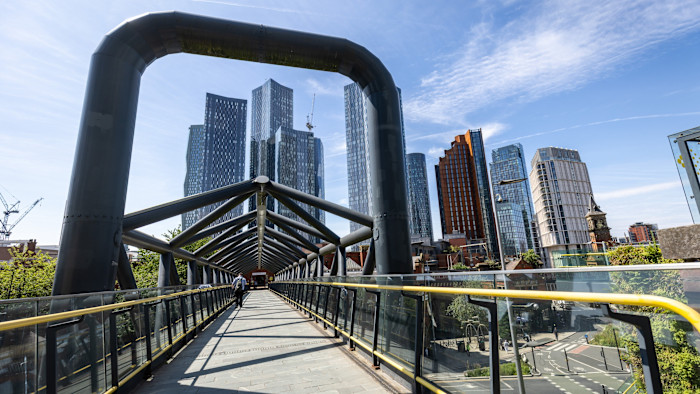
What followed was not just one tower but a brand-new skyline. A gleaming forest of glass that sprouted seemingly from nothing in a city best known for its football and its 1980s and ’90s music heyday. Today, it is the backdrop for Prime Minister Andy Burnham’s new Number 10 North.
The luxury skyscrapers, where young influencers live alongside Emirati postgraduates and the odd football manager, were part of a deliberate regeneration strategy by a town hall seeking to revive post-industrial Manchester. They now stand for the economic and political confidence of Britain’s third-largest city, as well as the tension inherent in Burnham’s newly coined term “Manchesterism”: his argument that the city’s revival is a blueprint for the country.
Soon there will be more towers. In a railway arch off Deansgate, a former car showroom, Robert De Niro last year broke ground on the 76-storey branded Nobu building, which is set to be the city’s tallest yet.
A fly-through video shows the polished bling of Dubai. That is perhaps no coincidence: a decade ago, foreign investment in Manchester came from China. Now it is the Gulf.
Nobu’s developer Salboy, which is also building former footballer Gary Neville’s nearby residences W, has seen interest switch over five or six years from Asian investors to high-net-worth UK buyers and the Middle East. The region is now Salboy’s busiest international market, accounting for more than 21 per cent of sales at W. City centre estate agent Julie Twist says one of the biggest drivers is the city’s universities. “It’s increasingly common for families to buy rather than rent while their children study here.”
Meanwhile there has been a visible rise in Middle Eastern food and drink options. On Deansgate, the coffee shop Gulf shows this new influence; opposite, a Lebanese restaurant is relocating from the wealthy Cheshire suburb of Hale. Underneath Deansgate Square South is a popular alcohol-free Lebanese café.
When a resident offers to give me a tour, I am struck that the expansive lobby of the south tower feels like a five-star international hotel, from its heavily fragranced air to the polished floors and black-suited security guards. In basement car parks, Lamborghinis sit next to Porsches, Bentleys and the odd Ferrari.
Manchester is perhaps a natural home for showy international wealth: it has a longstanding eye for bling, influenced by Cheshire millionaires and cash-splashing footballers.
“This is a city that drinks first and eats after, with its mouth open,” wrote restaurant critic AA Gill, derisively, in 2010. Manchester tends not to dwell for too long on such snobbery, focusing instead on its own debates about the breakneck pace of change.
The skyscrapers appeared as living standards were being squeezed and Burnham himself leaned into resulting anxieties about housing inequality in his first 2017 run for mayor. This summer, the mayoral election triggered by his departure for Downing Street was again dominated by skyscraper politics. Nearly a decade on — with larger penthouses now selling for £4mn or more and letting for £14,000 a month — the Green Party demanded rent controls, accusing Labour of “growth for growth’s sake”. Burnham’s Labour successor, Bev Craig, landed in similar territory, calling for national powers to control rents. Reform UK capitalised on controversy surrounding millions of pounds loaned to help private developers build skyscrapers. Burnham himself criticised the approach as a candidate a decade ago, although the loans continued under his tenure.
So the towers sum up the tensions within “Manchesterism”. For while the city has changed at pace in the last decade, its progress has been more contested, and more disruptive, than Burnham’s rhetoric implies.
Manchester’s internal debates are now in the national spotlight. And as Burnham’s new Number 10 finds its feet, London lobbyists and consultants heading north will soon be able to interpret the skyline for themselves.
[email protected]
