


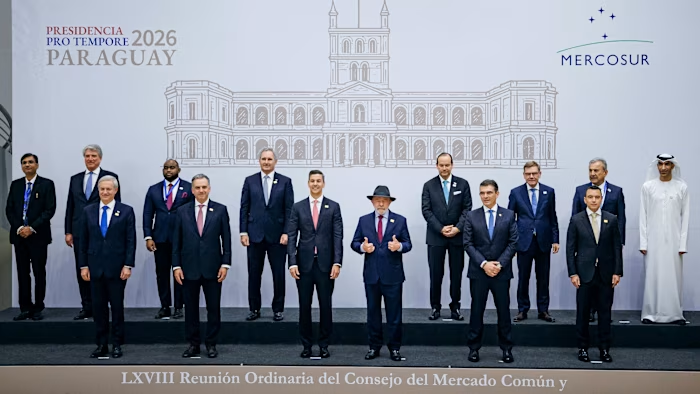
South American countries are hunting for global trade deals from Canada to the Gulf and Asia, as a historically inward-looking group seeks to hedge against rising geopolitical instability.
Mercosur, the customs union comprising Argentina, Bolivia, Brazil, Paraguay and Uruguay, is pursuing talks with capitals around the world, as it aims to boost the foreign trade of one of the most closed regional blocs.
“We are in a phase unlike any we have experienced before. It is perhaps the most active for Mercosur in terms of pursuing trade agreements and other deals [outside Latin America],” said Philip Fox-Drummond Gough, head of economic and financial affairs at Brazil’s foreign ministry and Mercosur negotiator.
Officials have said they hope to seal the terms of a trade deal with Canada by the end of 2026, while Mercosur and Japan in June officially launched negotiations for an economic partnership. Trade talks are also in progress with countries including the United Arab Emirates, India and Vietnam.
Mercosur exports currently represent less than 20 per cent of combined GDP, according to analysts, far below the global average.
But upheaval in international energy and food markets from wars in Ukraine and the Middle East has presented new opportunities for a bloc that is among the biggest producers of hydrocarbons, minerals and agricultural commodities.
The dealmaking push follows a long-awaited blockbuster free trade agreement with the EU that took effect this year and as US President Donald Trump’s trade policies and military conflicts disrupt global commerce.
On the South American continent, Argentina’s free-marketeer president, Javier Milei, has also applied pressure to open up the trade bloc.
Diplomats and trade experts said these factors — combined with rising US-China rivalry — had encouraged “middle power” countries to seek out or deepen commercial relationships to guard against supply-chain shocks.
“The multilateral trading system is basically not operational at this point in time,” said Roberto Azevêdo, a former Brazilian diplomat and former director-general of the World Trade Organization, describing “a more fragmented and anarchic world.”
“The way to achieve predictability in a very unpredictable world is to have alternatives . . . to be able to pivot to new opportunities and new markets,” added Azevêdo, who now runs 9G Consulting and Advisory Services.
Mercosur’s quest has, however, been overshadowed in recent weeks by a diplomatic dispute between Buenos Aires and Brasília. After Milei repeatedly insulted his counterpart and ideological foe Luiz Inácio Lula da Silva, Brazil downgraded diplomatic ties with its neighbour.
Even so, the bloc’s deal-hunting should survive, said Welber Barral, a former Brazilian trade official and founder of consultancy BMJ & Associates.
“All Mercosur countries have an interest in these agreements. Milei’s Argentina was one of the most enthusiastic for the EU deal,” added Barral. “Regardless of the bad relationship between Brazil and Argentina, or even disputes with smaller members, these moves will continue.”
Strain within Mercosur had, in some ways, fuelled the push for trade deals, analysts said. Argentina’s Milei last year called the bloc an “iron curtain” and threatened to withdraw unless it began “pro-free-trade reforms”.

Since then, Buenos Aires has signed a bilateral trade agreement with Washington and, along with Uruguay, declared its intention to join the 12-country Comprehensive and Progressive Agreement for Trans-Pacific Partnership. The move challenges Mercosur’s restrictions on members striking solo deals.
“Argentina is clearly pushing the boundaries of Mercosur,” said Marcelo Elizondo, an Argentine trade expert.
Analysts have said this has piled pressure on Brazil’s Lula, whose leftist Workers’ Party had historically been cautious on trade liberalisation.
Elizondo said Lula had realised the South American bloc could face a crisis if it continued to be closed and isolated.
“He understands this trade push as a way to strengthen Mercosur . . . while also demonstrating his commitment to multilateralism in opposition to Trump’s protectionism,” he added.
Washington announced an extra 25 per cent tariff on many Brazilian goods in July, reigniting bilateral tensions.
Mercosur’s renewed negotiations elsewhere in the world had allowed the bloc to demonstrate its capacity to strike bigger and better deals “than any member could in isolation”, said Patricia Frutos, Paraguay’s vice-minister for economic relations and integration.
Officials and analysts, however, cautioned that the negotiations might face obstacles, as illustrated by the long-delayed EU accord, which was signed in January after more than a quarter of a century of stop-start attempts.
As a major supplier of basic foodstuffs, Mercosur often faces resistance from farming lobbies over prospective commercial accords. This was among the main reasons for the protracted hold-up in the EU deal, along with environmental concerns such as deforestation.
Mercosur also concluded trade negotiations last year with the European Free Trade Association — comprising Switzerland, Norway, Iceland and Liechtenstein — and signed a deal with Singapore in 2023, its first with an Asian country.
