

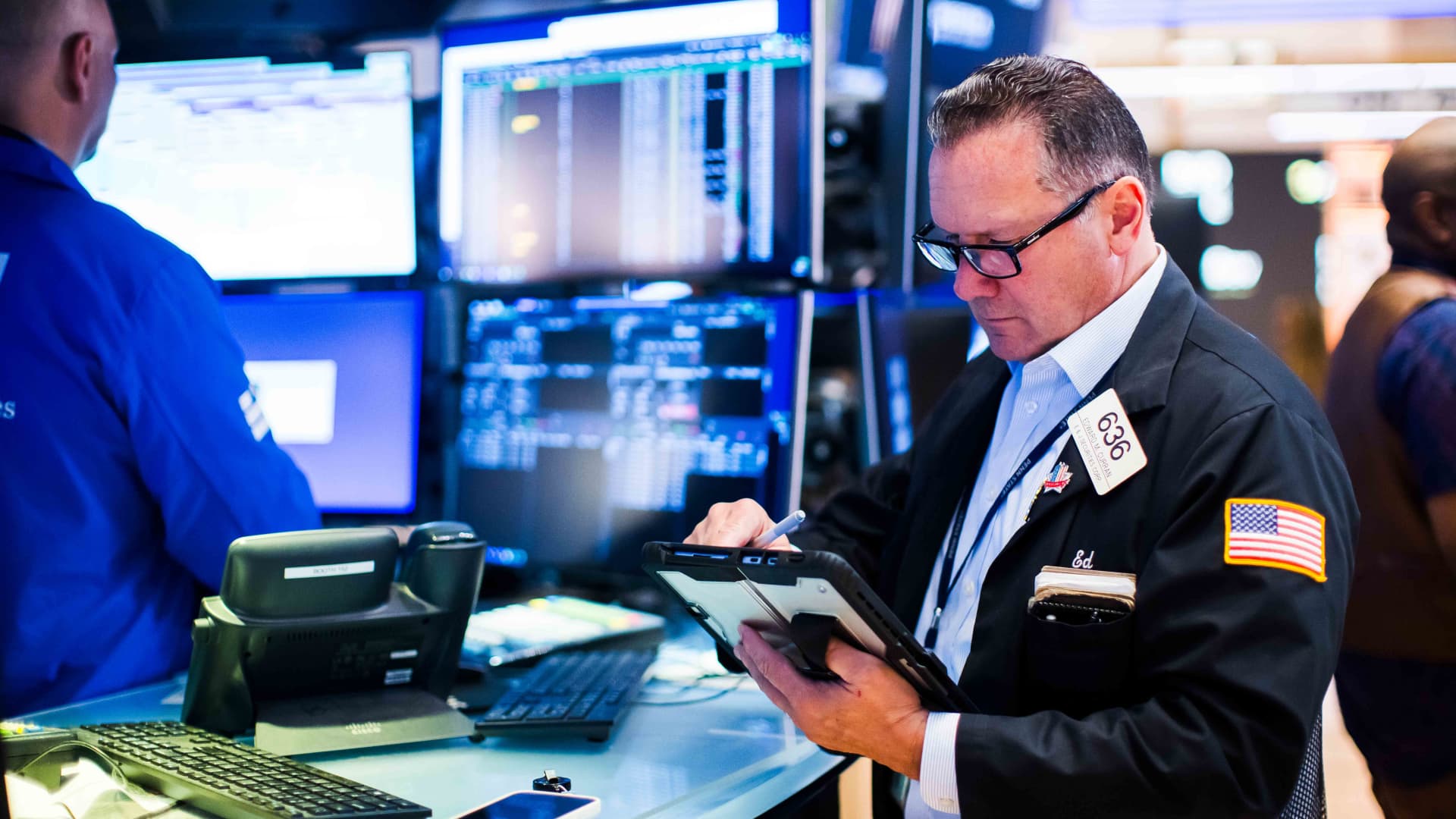
A trader works on the floor of the New York Stock Exchange.
NYSE
Goldman Sachs’ Ashok Varadhan has a simple message for investors worried about higher interest rates, elevated oil prices and the durability of the economy: stay invested.
Varadhan, the firm’s co-head of global banking and markets, pointed to three reasons for his constructive outlook: He doesn’t expect the Federal Reserve to raise interest rates this year, sees oil falling well below $70 a barrel later in 2026, and believes a resilient economy will increasingly benefit from productivity gains tied to artificial intelligence.
“Stay invested would be my advice,” Varadhan said in an episode of Goldman’s “The Markets” podcast last week.
His view on rates runs against market pricing that has reflected some risk the Fed could resume tightening amid lingering inflation concerns.
“I don’t think we will see hikes in the latter part of this year,” Varadhan said. “I think rates are going to stay on hold.”
Following a disappointing jobs report Friday, traders shifted their bets on when the Fed might hike. Odds for a move in September fell to around 50% on Monday and to 63% for October, according to the CME Group’s FedWatch gauge of futures prices.
Disinflationary force
Some of the forces that pushed inflation higher are beginning to recede, including the impact of tariffs, he said. An easing of geopolitical tensions around the Strait of Hormuz could further alleviate price pressures.
Varadhan also sees AI eventually becoming a disinflationary force. While the enormous infrastructure build-out needed to support artificial intelligence can strain resources and contribute to inflation in the near term, the productivity benefits should have the opposite effect once that capacity is in place, he said.
Oil is another reason for his optimism. Varadhan expects crude prices to retreat significantly as the year progresses, providing another potential source of relief on inflation.
“I think energy is going to go back down,” he said. “I think oil settles back down well below $70 a barrel, maybe even lower once we get towards the latter part of the year.”
West Texas Intermediate futures climbed back above $80 per barrel Monday as doubt grew that the U.S. and Iran will reach a deal to increase ship traffic through the Strait of Hormuz.
Resilient economy
The third pillar of Varadhan’s view is the resilience of the economy. Despite a series of external shocks, underlying nominal growth has remained remarkably durable, he said. If some of those pressures fade, the economy could continue to expand while benefiting from AI-driven productivity improvements.
That resilience is also keeping Varadhan constructive on credit. Heavy issuance means investors should demand somewhat more compensation for taking risk, he said, but the strength of the economy has helped prevent spreads from widening dramatically.
“If you think the exogenous shocks are going away and you still have the resilience of the economy,” Varadhan said, expectations for realized defaults can remain “fairly low.”
The S&P 500 has rallied back to a record high recently, bringing 2026 gains to more than 13%.
