
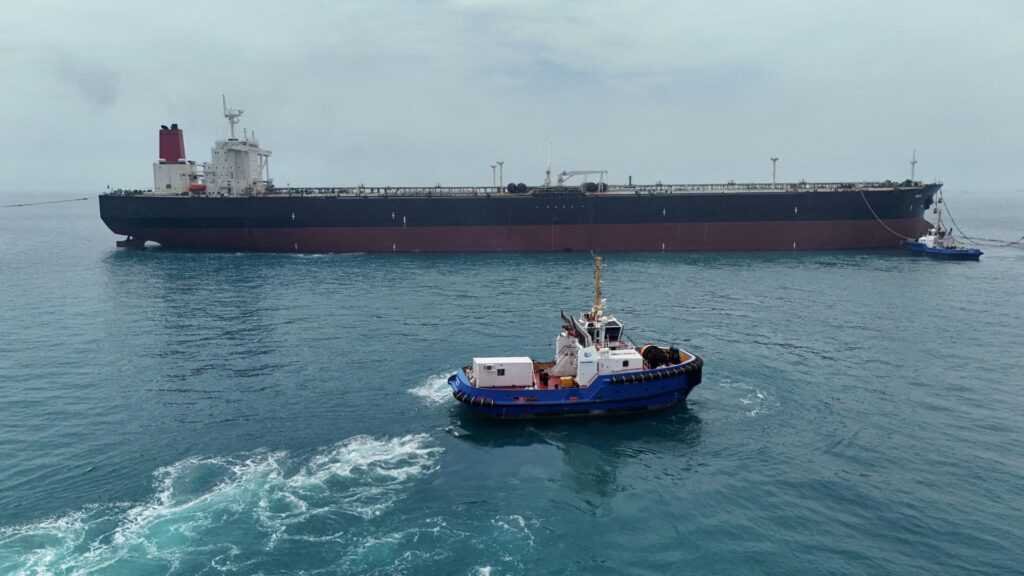
Drone view of oil tanker HELGA berthed at one of Iraq’s southern offshore oil terminals near Basra as it prepares to load crude oil, becoming the second vessel to arrive since the closure of the Strait of Hormuz, April 24, 2026.
Mohammed Aty | Reuters
President Donald Trump’s plan to impose a 20% fee on cargo passing through the Strait of Hormuz is threatening the global oil surplus, especially if renewed fighting shuts the key waterway again.
Analysts said the proposed levy matters less for its direct cost than for what it signals: a heightened risk that disruptions to shipping through the strait could lead to supply shortages, upending forecasts of a surplus made earlier this month.
Andy Lipow, president of Lipow Oil Associates, said on CNBC’s “Squawk Box Asia” that the market had been counting on stronger supplies following the U.S.-Iran memorandum of understanding signed last month, but that optimism has faded.
“Those surpluses are certainly in jeopardy, especially if the strait would completely shut down.”
Lipow estimates that Trump’s proposed fee, if applied to crude cargoes, would effectively add about $16 a barrel to oil shipped through the strait, though the administration has yet to clarify how the charge would be implemented.
Oil prices year-to-date
Citi warned that effecting the fee could also lift the possibility of a broader military confrontation in the near term.
“It is our view that the risks of military escalation have risen materially should this announcement be implemented,” Citi wrote in a note published early Tuesday.
“The possibility that the Iranian regime walks away from the MoU until after the mid-term U.S. elections has also risen, a scenario which would most likely see higher for longer oil prices,” Citi’s analysts added.
While the proposed levy would raise shipping costs, other experts said investors are increasingly focused on the possibility that an escalating conflict could remove barrels from the market altogether.
“The immediate impact is obviously supportive of oil prices, but the more consequential issue is the risk of renewed physical supply losses,” said Henry Hoffman, co-portfolio manager at Catalyst Energy Infrastructure Fund.
U.S. West Texas Intermediate futures for August delivery rose 2.27% to $79.91 per barrel. International benchmark Brent crude futures for September delivery climbed 2.14% to $85.11, extending gains after advancing 9.6% in the previous session.
Vessel traffic falls
If exporters are unable to ship crude out of the Gulf, storage tanks can eventually fill up, leaving producers with little choice but to temporarily halt production, said Hoffman. “That makes the effective supply loss potentially much greater than what can be measured simply by looking at damaged infrastructure.”
The latest developments would also undermine expectations from the International Energy Agency and others that global oil markets would remain comfortably supplied. The IEA just last week said it expects the oil market to return to surplus toward the end of 2026, though the outlook hinged on tanker traffic through the strait gradually recovering.
The timing could prove especially challenging if Asian demand rebounds just as Middle Eastern supplies become less dependable, he added. “Saudi Arabia recently moved its primary Asian crude grade from an enormous premium to a discount, which should encourage Chinese refiners to increase purchases after imports fell sharply during the initial disruption.”
Saudi Aramco recently cut prices by $11 per barrel to a $1.50 discount versus the Oman/Dubai benchmark.
“In other words, Chinese demand may begin recovering just as the reliability of Middle Eastern supply is deteriorating again.”
