
Unlock the Editor’s Digest for free
Roula Khalaf, Editor of the FT, selects her favourite stories in this weekly newsletter.
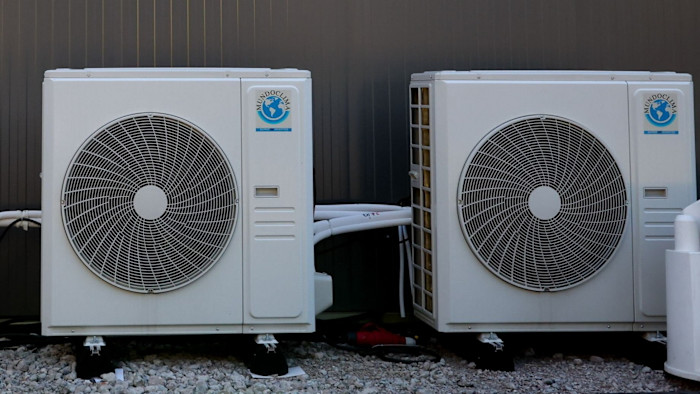
Europe’s heatwave last week sparked feverish debate over air conditioning — or the lack of it. And with creaking electricity grids and strained consumers, is cool air even affordable? The answer is yes.
It’s not hard to see why there is doubt over energy systems’ ability to cope with extra demand. As temperatures soared across the continent, so did power prices. Britain’s electricity infrastructure groaned: the grid operator called for extra supplies and paid for them through the nose.
But anxiety on this front is mostly misguided: in the clean energy system Europe is trying to build, air conditioning basically comes for free.
One way to think about it is that, in order to switch from polluting oil-fuelled cars and gas boilers to electric vehicles and heat pumps, the continent must invest $3.5tn into its electricity system, Goldman Sachs’ estimates. A sizeable chunk will go on turbines, panels and transport capacity used only in winter, because moving to electric heating means that that’s when demand will be at its highest.
Just look at the UK. Peak electricity demand in winter is expected to rise from a historic maximum of 60GW to over 100GW, according to modelling by the Energy Transitions Commission. That has to be supplied at an inconvenient moment for renewables: one with very little sun.
Summers, by comparison, are a walk in the park. Peak demand is expected to be perhaps 40 to 50 per cent lower than in winter, and solar production runs at full pelt. Even lashings of air conditioning — which Aurora Energy reckons might add 7-8GW to the summer peak by 2035 — would not require much additional investment along the value chain.
And while it’s true that air conditioning would mean households using much more electricity, they wouldn’t necessarily pay more. The cost to utilities of providing extra power in summer is negligible, so they might simply spread their capital costs over higher volumes.
There is one wrinkle: while summer demand is still lower than winter in the UK — peaking at 35GW last week according to data provided by Kraken, an energy platform, compared with last winter’s maximum of 46GW — the energy system tends to trip up when it is very cold or very hot. UK gas plants reported unplanned outages this week. And electricity imported from Europe was more expensive because French nuclear plants struggled to cool their reactors and had to lower output.
And the wind dies down too, something Germans call Kalte Dunkelflaute — cold dark wind lull — in winter and Hitzeflaute in summer. All this points to the fact that, as more supply comes from renewables and weather delivers new surprises, the energy system will need more flexibility.
But that isn’t too much to ask. Already, batteries provided 1GW of peak power this week. “Demand response” schemes, where consumers are paid to delay switching on the kettle, also kicked in. The UK’s energy regulator has meanwhile provisionally backed 16 new longer-duration electricity storage projects. Even amid the heat, cooler heads are prevailing.
[email protected]
