


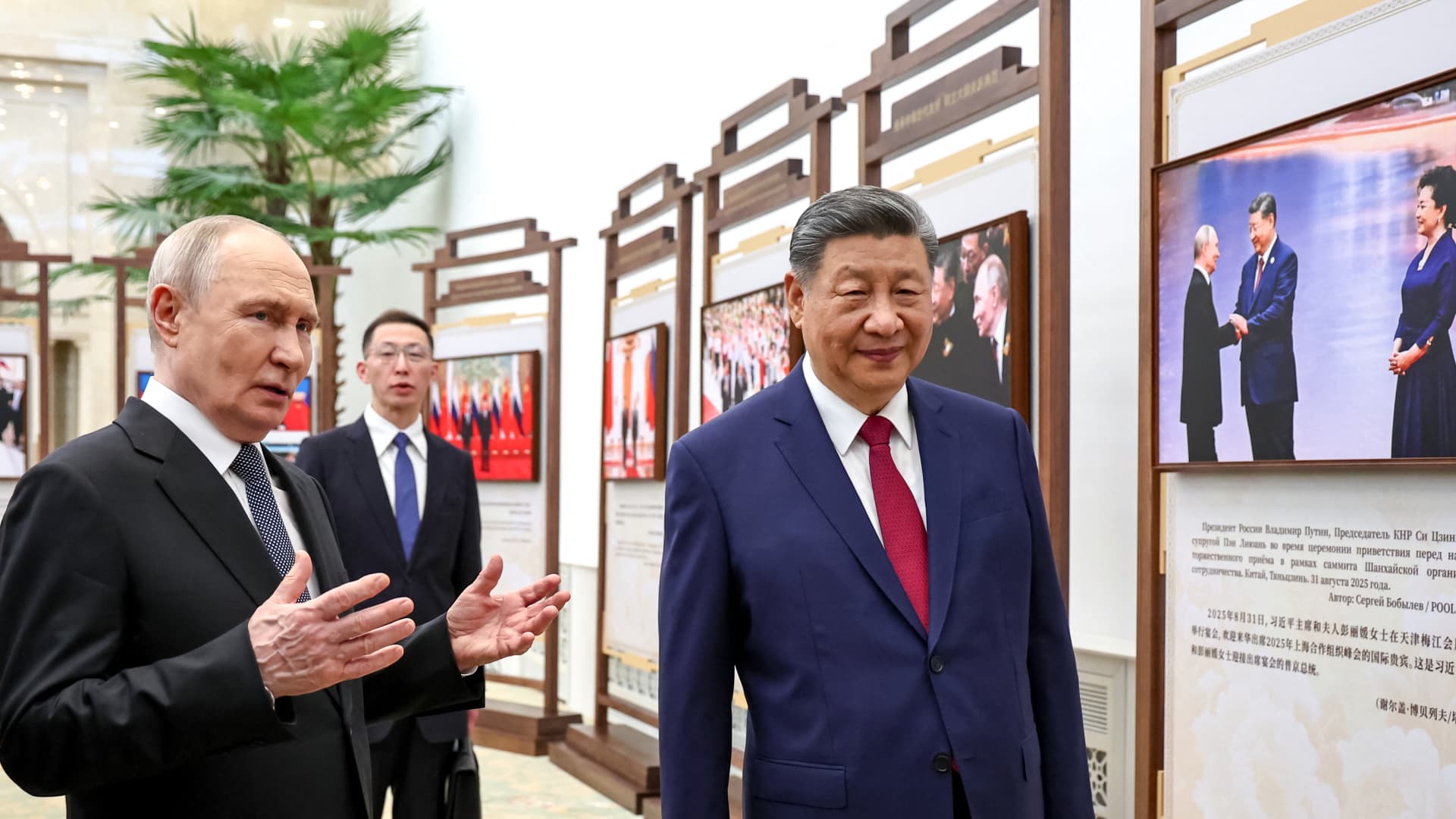
In this pool photograph distributed by the Russian state agency Sputnik, Russia’s President Vladimir Putin and China’s President Xi Jinping tour a photo exhibition on Russia-China ties in Beijing on May 20, 2026. (Photo by Alexander KAZAKOV / POOL / AFP via Getty Images)
Alexander Kazakov | Afp | Getty Images
Russian President Vladimir Putin left Beijing Wednesday with declarations of enduring friendship with China and a stack of bilateral agreements — but without the energy pipeline breakthrough Moscow was eyeing, signaling the evolving geometry of a partnership that is increasingly tilting in Beijing’s favor.
Little progress on gas deal
The two leaders failed to reach a breakthrough on the Power of Siberia 2 pipeline that Moscow had flagged would be “discussed in great detail,” as Russia’s gas exports to Europe have substantially shrunk following its invasion of Ukraine in 2022.
Following the summit, Russian Press Secretary Dmitry Peskov said Beijing and Moscow had arrived at an understanding on the venture’s key parameters, but “some nuances remain to be ironed out,” with no clear timeframe for the project, according to a Google translation of news agency RIA Novosti‘s report in Russian.
While Chinese President Xi Jinping stated that energy cooperation should be the “ballast stone” in China-Russia relations, he made no mention of the pipeline.
“This is a huge setback for Russia and Putin, who hinted before the visit that a breakthrough was in the works,” said Lyle Morris, senior fellow on Chinese national security and foreign policy at Asia Society Policy Institute.
Beijing may be “playing hardball at a time when Russia has lost some leverage with the European Union shutting off certain gas flows from Moscow,” Morris said. “There is no way to sugarcoat it: Putin was embarrassed by the failure to agree to the pipeline.”
Moscow regards the natural gas project as critical to redirecting its gas exports from Europe to China, while Beijing is wary of becoming overly dependent on a single gas supplier. Russia has been one of China’s top energy suppliers and increased its oil shipments to Beijing after flows through the Strait of Hormuz were severely disrupted.
The two sides had signed a legally binding memorandum to advance construction of the Power of Siberia 2 pipeline in September 2025, but talks stalled over disagreements on pricing, financing terms and delivery timelines.
The long-delayed pipeline is projected to carry up to 50 billion cubic meters of natural gas per year from Russia to China via Mongolia, building on the existing Power of Siberia 1 system, which delivers about 38 billion cubic meters of gas to China annually.
‘Unyielding’ bonds and dealmaking
Despite the gas deal failure, Beijing and Moscow signed a sweeping package of over 40 deals on trade, education, technology, nuclear security, among others, signaling momentum in the longstanding bilateral ties.
Leaders of the two nations heralded their “unyielding” bonds and pledged to deepen “good neighborliness and friendly cooperation,” with Xi hailing that bilateral relations were at “their highest level in history.”
China is Russia’s largest trading partner, though Moscow accounts for only about 4% of Beijing’s total trade, skewing the relationship in favor of China.
China and Russia also agreed to deepen military trust and cooperation, including expanding joint exercises, air patrols, and maritime patrols.
On Taiwan, Moscow reaffirmed its support for the “One China principle,” which holds the island as part of Chinese territory and opposition to any form of independence for Taiwan. On Ukraine, China said it continues to favor a diplomatic solution to the conflict, while resolutely supporting Russia’s sovereignty and territorial integrity.
Taking a thinly veiled swipe at Washington, the two sides condemned military strikes on third countries, the assassination of leaders of sovereign states, and efforts to destabilize their domestic political environments as serious violations of international law.
Such “external destructive interference” is the primary driver of instability across Eurasia, the joint statement said.
A delicate act
Putin’s visit came on the heels of U.S. President Donald Trump’s visit, with Beijing rolling out an almost identical welcome for the Russian leader: a red carpet on the tarmac, lines of children waving flags and clutching flowers.
Xi welcomed both leaders with a ceremony full of pomp and ritual outside the Great Hall of the People in central Beijing, with a 21-gun salute echoing across Tiananmen Square. While Trump arrived flanked by a dozen business executives, including CEOs of Apple, Tesla and Nvidia, Putin’s entourage consisted largely of deputy premiers, ministers and heads of state-backed oil and gas companies.
“There was a very delicate, nuanced stance to ensure that there was sort of rough equivalence in China’s relationship with those two leaders,” Evan Medeiros, Penner family chair in Asian Studies at Georgetown University, told CNBC’s “The China Connection.”
For Xi, the back-to-back visits underscored his increasing centrality to global events, Medeiros said. “Xi Jinping is clearly trying to position China as the indispensable external power in international politics,” he said, referring to a host of leaders who have visited China in recent months from European, Middle Eastern, and African countries.
“This is really China’s bid to say that it is a leading power, if not the leading power in the world,” Medeiros noted.
Compared to Trump, who was making only his second trip to China, Putin has been to the country more than 20 times during his over quarter-century in power.
